


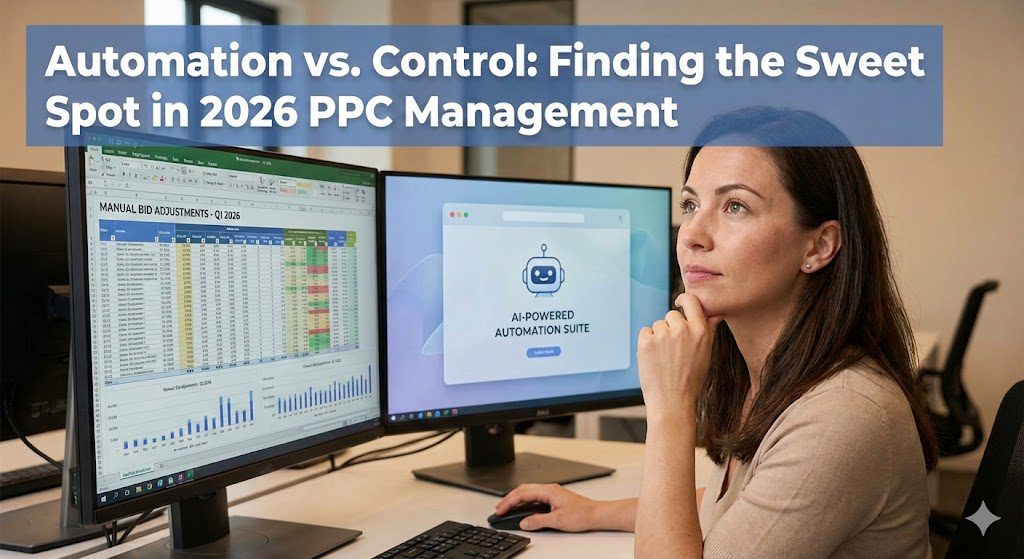
The pay-per-click advertising landscape underwent a seismic transformation over the past five years, fundamentally altering how digital marketers approach campaign management. What started as hesitant experimentation with automated bidding strategies has evolved into a full-scale industry shift toward AI-driven campaign optimization. Yet here we stand in 2026, watching many advertisers struggle with a critical question that keeps them awake at night: how much control should I surrender to automation, and where do I draw the line?
The uncomfortable reality? Most PPC professionals remain trapped between two extremes. On one side, there are those clinging desperately to manual management techniques that worked brilliantly in 2018 but now deliver diminishing returns. On the other, we see advertisers who’ve embraced automation so completely that they’re essentially spectators in their own campaigns, watching helplessly as algorithms make inexplicable decisions with their marketing budgets.
Neither approach represents the future of successful PPC management.
This comprehensive guide cuts through the noise, examining the evolving relationship between automation and human oversight in 2026 PPC campaigns. You’ll discover exactly where automation excels (and where it catastrophically fails), how to architect campaign structures that leverage AI without becoming its hostage, and what the most sophisticated advertisers are doing right now to dominate their markets while their competitors flail between manual micromanagement and blind automation trust.
The stakes have never been higher. According to recent industry research, advertisers who’ve found the optimal automation-control balance are achieving 35-65% better ROAS than those operating at either extreme. The question isn’t whether to use automation—that ship has sailed—but rather how to wield it strategically while maintaining the human expertise that separates exceptional campaigns from mediocre ones.
The Automation Revolution: Understanding Where We Are in 2026
Let’s establish context before diving into strategies. The PPC automation landscape in 2026 bears little resemblance to what existed just three years ago. Performance Max campaigns, which felt experimental and controversial in 2023, now account for over 40% of total Google Ads spend across advertisers. Meta’s Advantage+ campaigns operate with similar sophistication, making targeting decisions that would have required hours of manual analysis just 24 months ago.
The platform algorithms analyze literally billions of signals in real-time—device type, location, time of day, weather patterns, user search history, browsing behavior, demographic characteristics, contextual relevance, and hundreds of other factors that no human could possibly process manually. The machine learning models powering Smart Bidding strategies adjust bids thousands of times daily based on conversion probability calculations that would require a team of data scientists to replicate manually.
This isn’t your grandfather’s Google Ads anymore. The platforms have evolved from simple auction systems requiring constant bid adjustments into sophisticated AI ecosystems that can genuinely outperform manual optimization in specific circumstances. The operative phrase being “in specific circumstances.”
Here’s what changed most dramatically: the relationship between advertiser input and campaign performance. In traditional PPC management, your success correlated directly with your tactical execution. Skilled keyword research, precise match type selection, granular bid adjustments, and meticulous negative keyword management translated directly into better results.
In 2026’s AI-first environment, tactical execution matters far less than strategic direction. The advertisers winning today aren’t those who can set the perfect keyword bid—they’re those who can design better conversion signals, architect smarter campaign structures, and provide algorithms with high-quality inputs that guide optimization toward genuine business objectives rather than vanity metrics.
This fundamental shift explains why so many experienced PPC managers feel disoriented. The skills that made them successful a decade ago—bid management expertise, match type mastery, granular audience segmentation—now matter significantly less than strategic capabilities many never developed: data architecture design, conversion signal optimization, measurement framework development, and algorithmic goal alignment.
The Great Myth: Automation as an All-or-Nothing Decision
Perhaps the most damaging misconception plaguing PPC professionals in 2026 is treating automation as binary—either you embrace it completely or reject it entirely. This false dichotomy has created two camps of struggling advertisers.
Camp One consists of automation resisters who maintain manual CPC bidding, exact match keywords, and granular campaign structures despite mounting evidence that these approaches increasingly underperform. They point to isolated cases where Smart Bidding failed spectacularly, extrapolating these failures into blanket condemnations of all automation. Their campaigns languish with declining impression share and rising costs per conversion as competitors leverage algorithmic advantages they refuse to adopt.
Camp Two includes automation evangelists who’ve surrendered virtually all control to platform recommendations. They run broad match keywords with Smart Bidding, accept every automated campaign suggestion, and view their role as merely funding AI systems that will magically optimize everything. When performance inevitably deteriorates—usually because the algorithm optimized toward the wrong objectives or exploited attribution loopholes—they lack the expertise or structural controls to intervene effectively.
Both groups miss the fundamental insight that will define successful PPC management through 2026 and beyond: automation and control aren’t opposing forces but complementary capabilities that skilled advertisers orchestrate strategically.
Think of advanced PPC management as conducting an orchestra rather than playing a solo instrument. The conductor (you) doesn’t play every instrument personally—that would be impossible and inefficient. Instead, you select talented musicians (automation systems), provide clear direction about the piece you’re performing (business objectives), guide interpretation and tempo (strategic parameters), and intervene when sections drift off-key (performance monitoring). The result dramatically exceeds what any individual could accomplish alone.
The orchestration metaphor reveals why the automation-versus-control framing fails. Orchestras need both skilled musicians and expert conductors. PPC campaigns need both powerful automation and strategic human oversight. The question isn’t “which do I choose?” but rather “how do I combine them optimally?”
The Strategic Control Framework: Four Layers of PPC Management
Successful automation-control balance in 2026 requires understanding where to apply each approach across four distinct management layers. Getting this architecture wrong—applying manual control where automation excels, or surrendering control where human judgment remains superior—tanks campaign performance regardless of budget or creative quality.
Layer One: Strategic Direction (100% Human Control)
This layer encompasses your fundamental business objectives, target audiences, value propositions, and competitive positioning. Automation cannot and should not operate at this level because algorithms lack business context, strategic vision, and market understanding that only humans possess.
Strategic decisions requiring complete human control include:
Business Objective Definition: Are you optimizing for new customer acquisition, total revenue, profit margins, market share expansion, or customer lifetime value? This determination fundamentally shapes every downstream decision but requires business knowledge algorithms don’t possess. A campaign optimized for immediate ROAS performs completely differently than one focused on long-term customer value—automation can execute either strategy brilliantly but cannot determine which strategy serves your business better.
Market Positioning and Messaging: Your core value propositions, competitive differentiators, and brand positioning require human strategic thinking. Automation can test message variations and optimize delivery, but deciding what positions you uniquely in your market demands strategic expertise, competitive intelligence, and brand understanding that algorithms lack entirely.
Audience Universe Definition: While algorithms excel at optimizing within defined audiences, determining which audiences to pursue requires market knowledge, customer insights, and strategic foresight. Should you expand into adjacent markets? Target competitor customers? Focus exclusively on high-value segments? These questions require human judgment informed by business strategy, not algorithmic optimization.
Budget Allocation Across Business Units: If you operate multiple business lines or service categories, determining how to distribute total marketing investment across these areas requires business strategy alignment that transcends what any campaign algorithm can determine. One product line might warrant investment despite poor immediate ROAS because it enables customer relationships that drive long-term value elsewhere. Another might deserve budget cuts despite strong reported performance because it attracts low-quality customers. These decisions require business context algorithms cannot access.
Risk Tolerance and Testing Philosophy: Your appetite for experimentation, comfort with performance volatility during learning periods, and willingness to sacrifice short-term results for long-term discovery all reflect business philosophy that humans must establish. Automation can operate within whatever risk parameters you define, but cannot determine appropriate risk levels for your specific business circumstances.
Getting this layer wrong typically manifests as letting platform recommendations dictate business strategy. We see this when advertisers accept Google’s suggestion to “expand targeting to reach more users” without considering whether those additional users actually serve business objectives. Or when they allow Meta to optimize for “maximum purchases” when their actual business goal involves acquiring high-lifetime-value customers, not merely driving transaction volume.
The strategic control principle: Never let automation answer “what” or “why” questions. Algorithms can optimize “how” and “when,” but determining your destination must remain entirely human-directed.
Layer Two: Campaign Architecture (Shared Control)
This layer involves structural decisions about campaign organization, conversion tracking design, attribution models, and measurement frameworks. Here we see our first area of nuanced automation-control balance, where human strategic design enables algorithmic optimization.
Decisions requiring collaborative human-AI approach:
Campaign Structure Design: The decision to run one consolidated campaign or multiple segmented campaigns reflects both strategic considerations (business objectives) and practical constraints (conversion volume). Humans should determine the strategic segmentation logic (by product category, customer type, geographic region, etc.), but consider automation requirements when making these architectural decisions.
Example: An e-commerce retailer might want to segment campaigns by product category for reporting clarity and budget control. However, if most categories generate fewer than 30 conversions monthly, this segmentation will prevent effective automated learning. The optimal solution might involve consolidating smaller categories into a single campaign while separating only the highest-volume categories—a compromise between human strategic preferences and algorithmic operational requirements.
Conversion Tracking Architecture: How you define, value, and optimize conversions represents perhaps the single most impactful area where human design enables or undermines automation effectiveness. You must design conversion architectures that capture genuine business value while providing algorithms with clear, actionable optimization signals.
Critical conversion design decisions include:
- Which actions to track as conversions (purchases only, or include add-to-cart, email signups, and content engagement?)
- How to value different conversion types (all equal, or weighted by business impact?)
- What attribution model to apply (last-click, first-click, position-based, data-driven?)
- Whether to optimize toward single conversions or conversion value
- How to handle micro-conversions that don’t directly generate revenue but contribute to eventual purchases
These decisions require deep business understanding and strategic judgment, yet they directly determine how effectively automation can optimize. Design your conversion architecture poorly, and even the most sophisticated algorithms will optimize campaigns toward meaningless metrics or attribution artifacts that don’t reflect actual business impact.
Audience Signal Development: While Performance Max and Advantage+ campaigns expand beyond provided audience signals during optimization, the initial signals you provide dramatically influence learning speed and eventual performance. Developing high-quality audience signals requires human strategic thinking about customer characteristics, behavioral patterns, and intent signals, combined with automation’s ability to identify similar patterns at scale.
The optimal approach involves humans defining audience hypotheses based on customer understanding (our best customers typically research extensively before purchasing, often engage with comparison content, and show interest in premium product features), then providing these as signals that algorithms can use for initial targeting and eventual expansion.
Bid Strategy Selection and Configuration: The choice between Target CPA, Target ROAS, Maximize Conversions, or Maximize Conversion Value requires understanding business economics and strategic objectives. Should you maximize total volume within efficiency constraints, or maximize efficiency while accepting lower volume? Do you want to pay more to acquire new customers than you’ll pay for repeat purchases? These strategic questions require human judgment, but the tactical execution of achieving those targets should be delegated to Smart Bidding algorithms.
The architectural control principle: Design structures that align algorithmic optimization with business objectives, then allow automation to operate within those structures.
Layer Three: Tactical Optimization (Primarily Automated with Human Guardrails)
This layer encompasses bid management, audience expansion, placement optimization, creative rotation, and budget pacing—tactical decisions that algorithms generally handle more effectively than humans could manually, provided they operate within appropriate guardrails.
Areas where automation should dominate but human oversight remains necessary:
Bid Management and Budget Pacing: Smart Bidding strategies should control individual auction bids and daily budget pacing. The algorithms process vastly more signals and can respond to patterns faster than any human. However, humans should establish boundaries (maximum CPA thresholds, minimum ROAS requirements) and monitor for algorithmic drift or systematic errors.
Appropriate human intervention involves setting performance boundaries and monitoring aggregate trends, not micromanaging individual keyword bids or placement adjustments. If your Target CPA campaign consistently exceeds your target by 50% over multiple weeks, that signals a need for strategic adjustment (target recalibration, conversion tracking audit, or campaign restructuring), not tactical bid management.
Audience Targeting and Expansion: Within Performance Max, Demand Gen, or Advantage+ campaigns, allow algorithms to identify and test audience segments beyond your initial signals. These systems excel at discovering unexpected audience segments that convert well, often identifying patterns humans would never notice.
However, implement monitoring systems to detect when expansion goes off-rails. Review audience insights reports monthly. If you’re a B2B software company suddenly generating most impressions on gaming websites, that suggests the algorithm has drifted from your target market despite delivering conversions (likely low-quality leads that won’t actually purchase). Such discoveries warrant strategic intervention—adding placement exclusions, refining audience signals, or adjusting conversion definitions—not disabling automation entirely.
Creative Rotation and Dynamic Combinations: In campaigns where you’ve uploaded multiple assets, allow automation to test combinations, identify winners, and allocate impressions accordingly. These systems test variations far more efficiently than humans could manually.
The tactical exception where human control outperforms involves brand messaging consistency in certain industries. Automated creative combinations might inadvertently create messaging that technically performs well but conflicts with brand guidelines, legal requirements, or strategic positioning. Financial services, healthcare, and other regulated industries often require creative pre-approval rather than algorithmic combination, even if this sacrifices some performance optimization.
Placement Optimization: Within Display, YouTube, and Performance Max campaigns, algorithms should generally control where your ads appear within Google’s network. The systems optimize placement performance far more efficiently than manual placement lists.
However, implement brand safety guardrails through content exclusions and sensitive category blocks. Review placement reports quarterly to identify any systematic issues—perhaps your ads appear predominantly on content tangentially related to your products but attracting low-intent traffic. Such patterns warrant strategic intervention through URL exclusions or topic blocks, not manual placement micromanagement.
Seasonal and Temporal Adjustments: Rather than manually adjusting bids for day-parting or seasonal patterns, use automation tools like seasonality adjustments in Google Ads or scheduled rules. These allow you to inform algorithms about expected performance changes (we’re launching a major sale; we expect conversion rates to double this week) without disrupting automated bid management.
The tactical automation principle: Let algorithms handle moment-to-moment optimization decisions, but establish guardrails that prevent algorithmic drift and monitor for systematic issues requiring strategic intervention.
Layer Four: Quality Assurance and Strategic Intervention (Human Control for Exception Management)
The final layer involves monitoring campaign performance, identifying when results deviate from expectations, diagnosing root causes, and implementing corrective interventions. This requires uniquely human capabilities: strategic pattern recognition, business context integration, and exception management.
Critical human responsibilities in this layer:
Performance Anomaly Detection: While platforms provide automated alerts for certain issues (campaigns stopped serving, budgets exhausted, conversion tracking errors), humans must identify subtler performance degradation that algorithms might miss: gradual cost increases, declining impression quality, shifting traffic patterns, or attribution anomalies.
Effective monitoring involves establishing baseline performance expectations and identifying deviations that warrant investigation. If your usual CPA is $50 and it’s suddenly $75, that demands investigation regardless of whether the campaign technically operates within your Target CPA range. If 80% of conversions suddenly shift from click-through to view-through attribution, that suggests something changed (either positively or problematically) that requires human analysis.
Root Cause Diagnosis: When performance deviates from expectations, algorithms can’t diagnose why. Was it external factors (increased competition, seasonal shifts, market changes), internal factors (website issues, conversion tracking problems, product availability), or algorithmic factors (learning period disruption, targeting drift, creative fatigue)?
This diagnostic capability remains exclusively human because it requires integrating information from across business systems—website analytics, CRM data, inventory systems, competitive intelligence—that ad platform algorithms cannot access.
Strategic Intervention Design: Once you’ve diagnosed performance issues, determining the appropriate intervention requires strategic thinking about tradeoffs and second-order effects. Should you adjust targets, restructure campaigns, refresh creative, audit conversion tracking, or accept temporary underperformance during external market shifts?
These decisions require business judgment about acceptable tradeoffs (short-term efficiency versus learning investment, volume versus quality, brand consistency versus performance optimization) that algorithms cannot make independently.
Cross-Channel Strategy Integration: Your PPC campaigns don’t operate in isolation but as part of a broader marketing ecosystem. Humans must consider how PPC automation decisions affect and are affected by email marketing, content strategy, SEO, social media, and offline marketing activities.
For example, if your automated PPC campaigns increasingly focus on branded search terms because they convert efficiently, you might simultaneously underinvest in awareness building that ultimately feeds that branded search volume. Or if automation shifts budget heavily toward retargeting because it converts efficiently, you might inadvertently reduce new customer acquisition that sustains long-term growth. These strategic considerations require human oversight of the entire marketing system, not just individual campaign optimization.
Learning and Optimization Culture: Perhaps most importantly, humans must establish frameworks for systematic learning, documentation of insights, and continuous improvement of automation approaches. When you discover that certain audience signals drive better performance, or that specific conversion definitions improve optimization quality, or that particular campaign structures work better for your business—these insights should be documented, tested systematically, and incorporated into your ongoing automation strategy.
The quality assurance principle: Humans remain responsible for outcomes even when algorithms handle execution. Effective oversight means monitoring strategically, diagnosing intelligently, and intervening purposefully when algorithms require course correction.
The Conversion Signal Problem: Why Most Automated Campaigns Fail
Despite sophisticated algorithms and powerful automation capabilities, most PPC campaigns underperform dramatically not because the automation itself fails, but because advertisers provide algorithms with poor-quality signals that guide optimization toward wrong objectives. This represents perhaps the single most impactful yet least understood challenge in modern PPC management.
The fundamental issue: platforms optimize precisely toward whatever signals you provide. If those signals don’t accurately reflect genuine business value, automation will efficiently deliver results that look impressive in campaign dashboards but don’t actually grow your business.
The Attribution Inflation Trap
Consider the most common conversion signal problem: view-through conversion attribution. By default, Google Ads counts a conversion if someone saw your ad (without clicking) and subsequently converted within 24 hours through any channel. Meta employs similar attribution logic with even longer windows.
Why this breaks automation: view-through conversions often represent attribution artifacts rather than genuine advertising influence. Someone researches your product extensively, sees your retargeting ads across the web, visits your website directly by typing your URL, and completes a purchase. Your Performance Max campaign claims credit for that conversion despite the person never clicking your ad.
The algorithm treats this view-through “conversion” identically to click-through conversions where someone actively engaged with your ad before purchasing. It learns that showing impressions to users already searching for your brand delivers “conversions” efficiently, so it increasingly allocates budget toward retargeting and branded traffic even if you’re explicitly trying to acquire new customers.
The reported metrics look phenomenal—impressive ROAS, high conversion counts, strong performance across dashboards—but business growth doesn’t materialize proportionally because many attributed conversions would have occurred anyway without advertising influence.
Real-world impact: we’ve seen clients with Performance Max campaigns reporting 800% ROAS while total business revenue remained flat. Investigation revealed that 85% of attributed conversions were view-through, and the campaign had essentially become an expensive brand awareness tool claiming credit for organic brand searches and direct traffic. Once we implemented click-only conversion tracking, reported ROAS dropped to 220%, but actual incremental business revenue increased 43% as the algorithm began optimizing for genuine demand generation rather than attribution capture.
The Conversion Quality Problem
The second critical signal issue involves treating all conversions as equally valuable when business reality suggests otherwise. Most businesses generate conversions with dramatically different quality levels—some leads close at 40% rates with high contract values, others close at 2% with minimal revenue. Yet default conversion tracking treats all leads identically, guiding automation toward volume optimization rather than value optimization.
This manifests across virtually every business type:
E-commerce: Not all $100 purchases create equal customer value. First-time customers might generate $500 lifetime value while repeat customers generate $150 on average (already acquired, lower future purchase frequency). Treating these conversions identically guides automation toward repeat customers because they convert more easily, gradually reducing new customer acquisition that actually drives growth.
Lead Generation: A form submission from a decision-maker at a Fortune 500 company obviously differs from one submitted by a student researching a school project. Yet both typically count as identical “leads” in conversion tracking, guiding automation toward volume optimization rather than quality optimization.
B2B SaaS: A trial signup from a qualified prospect within your ideal customer profile differs fundamentally from one initiated by a competitor analyzing your product or a consultant exploring solutions they might recommend. Both register as “trial signups,” but only one creates genuine business opportunity.
Local Services: A phone call from someone ready to book service differs from someone asking basic questions they could have found on your website. Both often count as “phone call conversions,” but conversion value varies dramatically.
When conversion quality varies significantly but tracking treats all conversions equally, automation optimizes toward whatever audience converts most easily, not necessarily what drives the most business value. Over time, campaign performance migrates toward lower-quality, higher-volume conversions that look impressive in dashboards but don’t translate to proportional business growth.
The solution involves implementing conversion value strategies that weight conversions by actual business impact:
- Importing offline conversion values from CRM systems showing which leads actually closed
- Implementing value rules that assign higher values to new customers versus repeat purchasers
- Creating separate conversion actions for different quality tiers
- Using lead scoring data to assign probabilistic values to conversions before sales outcomes are known
The Micro-Conversion Dilution Issue
The third signal problem involves over-valuing micro-conversions relative to actual business transactions. Many advertisers track multiple conversion types—add-to-cart, email signups, content downloads, video views—and include all of them in campaign optimization either because they want comprehensive measurement or because they lack sufficient primary conversion volume.
The challenge: when algorithms optimize toward conversion portfolios that include numerous micro-conversions with minimal business value, they naturally gravitate toward whatever generates the most conversion events, not necessarily what drives the most business value. The system becomes rewarded for driving cheap, easy actions rather than valuable, difficult outcomes.
We frequently see this in B2B contexts where campaigns optimize toward a mix of “contact us” form submissions (high value), content downloads (medium value), and newsletter signups (low value). The algorithm quickly learns that newsletter signups occur far more frequently and easily than consultation requests, so it shifts budget toward audiences and placements that drive newsletter volume, gradually reducing emphasis on high-value conversion actions despite those being the actual business objective.
This doesn’t mean you shouldn’t track micro-conversions—they provide valuable insights into customer journey progression and campaign influence across funnel stages. However, you must architect conversion hierarchies that guide optimization toward high-value actions:
- Use conversion action sets to control which conversions actually influence bidding
- Implement value weighting that reflects genuine business impact ratios
- Create feeder campaigns that optimize toward micro-conversions to build audience pools for downstream campaigns that optimize toward final conversions
- Regularly audit what percentage of your conversions fall into each category to ensure algorithms haven’t drifted toward low-value actions
The conversion signal principle: Garbage in, garbage out applies perfectly to PPC automation. Invest as much effort in designing clean, business-aligned conversion signals as you invest in campaign setup and creative development. Automation quality cannot exceed signal quality.
The New Customer Acquisition Challenge: Teaching Algorithms What Actually Matters
Perhaps nowhere does the automation-control balance matter more than in new customer acquisition, where most automated campaigns fail spectacularly not through algorithmic inadequacy but through structural misalignment between what businesses actually need (net new customers) and what platforms naturally optimize toward (easy conversions from existing audiences).
The core challenge: algorithms naturally gravitate toward low-hanging fruit. When you launch a Performance Max or Advantage+ campaign and tell it to “maximize conversions” or “achieve a target ROAS,” the system quickly discovers that your existing customers, website visitors, and brand-aware audiences convert far more efficiently than cold prospects who’ve never heard of you.
This creates a powerful feedback loop. The algorithm shows ads to warm audiences, generates conversions, receives positive reinforcement, and doubles down on that successful approach. Meanwhile, cold prospecting receives limited budget, generates fewer conversions initially (expected, because cold prospects require more touchpoints), receives negative reinforcement, and gets deprioritized. Over weeks and months, your “new customer acquisition” campaign gradually transforms into a retargeting and brand awareness campaign claiming credit for conversions that would likely have occurred organically.
The business impact can be devastating. Your dashboards show impressive ROAS, strong conversion counts, and efficient CPAs. But pipeline health deteriorates because you’re not actually acquiring new customers at sustainable rates—you’re just efficiently capturing existing demand while your competitor who’s investing in genuine prospecting gradually erodes your market position.
The New Customer Acquisition Framework for Automated Campaigns
Solving new customer acquisition in automated campaigns requires architecting structural controls that explicitly guide optimization toward net new customers rather than letting algorithms default to existing audiences:
Strategy One: Customer Exclusion Architecture
The most powerful approach involves explicitly excluding existing customers from acquisition campaigns through customer match lists, then using bidding strategies that prioritize new customer acquisition:
Implementation process:
- Upload comprehensive customer lists including all purchasers from the past 24-36 months to Google Ads and Meta as customer match audiences
- Create dedicated new customer acquisition campaigns with explicit customer exclusions applied
- Enable “new customer acquisition” bidding in Google Ads (available in Performance Max and Search campaigns), which allows you to bid more aggressively for users who aren’t existing customers
- Set value rules that weight new customer conversions 2-3x higher than repeat purchases
- Run parallel campaigns optimizing for customer lifetime value rather than first purchase value
This architecture forces algorithms to find genuinely new customers rather than defaulting to existing audiences. Yes, your apparent ROAS will initially decline—perhaps by 40-60%—because acquiring cold prospects costs more than recapturing existing customers. But actual business growth accelerates because you’re driving incremental customers rather than claiming credit for inevitable purchases.
Real-world results: after implementing customer exclusion architecture, a subscription box company saw reported ROAS drop from 520% to 310% (reality check on previous attribution inflation), but new customer acquisition rates tripled, lifetime value improved by 47%, and total business revenue grew 89% over six months. The algorithm hadn’t failed previously—it had simply been optimizing toward the wrong objective because they’d failed to architect proper controls.
Strategy Two: Conversion Definition Separation
The second powerful approach involves creating explicitly different conversion actions for new customers versus existing customers, then building campaigns that optimize exclusively toward new customer conversions:
Implementation approach:
- Implement conversion tracking that identifies whether purchasers are new or returning customers (requires email/user ID tracking)
- Create separate conversion actions: “First Purchase” and “Repeat Purchase”
- Build campaigns that include only “First Purchase” in their conversion action set
- Optionally assign higher conversion values to first purchases to reflect customer acquisition value
This prevents algorithms from substituting easy repeat purchase conversions for difficult new customer acquisitions, because the campaign literally doesn’t see or get credit for repeat purchases. It must find new customers to generate any conversions at all.
Strategy Three: The Prospecting-Retargeting Campaign Split
The third architectural approach involves explicitly separating prospecting campaigns (focused on cold audiences) from retargeting campaigns (focused on warm audiences), preventing the mixing that allows algorithms to naturally drift toward retargeting:
Structure design:
- Create Performance Max campaigns explicitly for prospecting with audience signals focused on cold audiences (competitor customers, in-market audiences, lookalike audiences) and customer match lists excluded
- Create separate Performance Max campaigns for retargeting with website visitor audiences and customer match lists as primary signals
- Allocate budget proportionally to business priorities (typically 60-70% prospecting, 30-40% retargeting)
- Monitor to ensure prospecting campaigns maintain focus on cold audiences rather than drifting toward website visitors
The separation prevents algorithms from solving your prospecting campaign by essentially converting it into retargeting, because retargeting audiences are literally removed from the prospecting campaign’s available inventory.
Strategy Four: Feeder Campaign Architecture
For businesses with limited conversion volume that makes new customer acquisition optimization difficult, the feeder campaign approach builds audience pools that downstream campaigns can leverage:
Implementation framework:
- Create top-of-funnel campaigns optimizing toward micro-conversions (content engagement, video views, website visits) with cold audience signals
- These campaigns build retargeting pools of users who’ve engaged but not yet purchased
- Create mid-funnel campaigns targeting those engaged audiences, optimizing toward add-to-cart or lead form initiation
- Create bottom-funnel campaigns targeting mid-funnel engagers, optimizing toward final purchases or lead submissions
- Each stage builds progressively warmer audiences for the next stage while maintaining focus on ultimate new customer acquisition
This architecture works well when you can’t generate enough direct conversions from cold traffic to support effective Smart Bidding, but you can generate sufficient micro-conversions to feed the optimization funnel.
The new customer acquisition principle: Default automation optimizes for easy conversions, not necessarily valuable ones. Architectural controls that explicitly guide optimization toward your actual business objective—net new customers—dramatically outperform hoping algorithms figure this out independently.
When Manual Control Still Wins: The Exceptions to Automation
Despite powerful automation capabilities, specific scenarios remain where manual control delivers superior results, and attempting to force automation into these contexts typically backfires. Recognizing these exceptions prevents you from fighting automation where it excels while ensuring you maintain control where human judgment actually matters.
Exception One: Brand Protection and Branded Search
Branded search terms—queries containing your company name, product names, or branded phrases—represent a unique case where automation often misallocates resources and where manual control typically delivers better economics.
Why automation struggles: Performance Max and broad match automation naturally prioritize branded terms because they convert exceptionally well. Someone searching “[Your Company Name] pricing” represents the highest intent possible—they already know who you are and are researching purchase. These queries deliver stellar ROAS, so algorithms allocate increasing budget toward them.
The problem: you likely would have captured these conversions anyway through organic search results. Paying for clicks on your own brand name when you rank #1 organically represents questionable ROI, yet automated campaigns enthusiastically bid on these terms because reported conversion efficiency looks phenomenal.
The manual control solution:
- Create dedicated branded search campaigns with exact match brand keywords
- Set relatively low bids (often 10-20% of non-brand bids) to capture brand traffic economically
- Add comprehensive brand negative keywords to all automated campaigns to prevent them from cannibalizing brand traffic
- Monitor search term reports to identify brand term leakage into automated campaigns
- Track incremental branded search volume over time as your prospecting campaigns build awareness
This manual structure ensures you capture brand searches economically while forcing automated campaigns to focus on non-brand prospecting where they actually add value.
Exception Two: Limited Budget with Niche Targeting
When you operate with severely limited budgets (under $30-50 daily) and highly specific targeting requirements (local service areas, niche professional audiences, specialized product categories), manual control often outperforms automation because insufficient conversion volume prevents effective machine learning.
The mathematical reality: Smart Bidding strategies require meaningful conversion data to optimize effectively. Google’s documentation suggests minimum 30 conversions per month, but practical experience suggests 50-100+ monthly conversions for genuinely effective optimization. Below these thresholds, algorithms lack sufficient signal to distinguish effective from ineffective bid adjustments.
When to maintain manual control:
- Local businesses serving small geographic areas generating 10-20 monthly conversions
- Niche B2B services with highly specific buyer personas and long sales cycles
- Specialized products with small addressable markets
- Seasonal businesses outside their primary season
- New campaigns in their first 30-60 days before sufficient conversion data exists
Manual control approaches for low-volume scenarios:
- Manual CPC bidding with bid adjustments for device, location, and time of day
- Portfolio bidding strategies that aggregate data across multiple campaigns to reach minimum thresholds
- Click-based optimization strategies (Maximize Clicks) rather than conversion-based when conversion volume is extremely limited
- Focus on audience layering and negative keywords rather than algorithmic optimization
The transition plan: implement manual control during low-volume periods or campaign launch phases, but plan transition to automated bidding once conversion volume reaches sustainable thresholds. Don’t remain trapped in manual management indefinitely if growth creates opportunity for automation to deliver better results.
Exception Three: Compliance-Heavy and Regulated Industries
Certain industries face regulatory requirements and compliance obligations that make fully automated campaign types problematic. Financial services, healthcare, legal services, and other regulated industries often require message pre-approval, specific disclaimer inclusion, and restrictions on targeting that automated creative combination and dynamic audience expansion can violate.
Compliance challenges with automation:
- Automated creative combinations might generate messaging that technically performs well but violates regulatory requirements
- Dynamic audience expansion might target demographics or psychographic segments explicitly prohibited by regulation
- View-through attribution might over-claim credit for conversions in ways that violate accurate performance reporting requirements
- Automated budget shifts might violate marketing investment caps required by regulatory frameworks
Manual control requirements:
- Pre-approve all creative combinations rather than allowing dynamic assembly
- Use manual or automated bidding with strict audience controls rather than broadly expanding automated campaigns
- Implement stricter placement controls and content exclusions
- Require explicit legal review for all creative assets before upload
- Maintain detailed documentation of optimization decisions for compliance audits
This doesn’t mean regulated industries can’t use any automation—Smart Bidding strategies work perfectly well within compliant campaign structures. But it does mean certain automation types (Performance Max, Dynamic Search Ads, dynamic creative optimization) require careful configuration or outright avoidance to maintain compliance.
Exception Four: Crisis Management and Rapid Response
When urgent situations require immediate campaign adjustments—product recalls, PR crises, sudden competitive threats, flash opportunities—manual control enables response speed that automated optimization timelines cannot match.
Crisis scenarios requiring manual intervention:
- Product availability issues requiring immediate pause of affected campaigns
- Pricing errors necessitating instant campaign suspension
- Competitive promotions requiring rapid counter-offers
- PR crises demanding immediate message pivots
- Sudden budget restrictions requiring controlled spend reduction
In these scenarios, waiting for algorithms to “learn” new parameters over days or weeks isn’t viable. You need immediate, precise control that only manual management provides.
The crisis response framework:
- Maintain campaign structures that allow rapid manual intervention even when typically running automated strategies
- Document crisis response procedures before emergencies occur
- Ensure team members have appropriate permissions to implement emergency changes
- Use campaign experiments to test crisis responses without disrupting entire account
- Plan for gradual return to automation after crisis resolves rather than leaving emergency manual controls in place indefinitely
Exception Five: Strategic Testing and Learning
When conducting strategic tests—new market entry, product launch, message testing, audience exploration—initial manual control often delivers better learning than immediate automation, because you need clean, interpretable data about what works before algorithmic optimization obscures those insights.
Testing scenarios favoring manual control:
- Testing fundamentally different value propositions where you need clear data on which message resonates
- Exploring new geographic markets where you don’t yet understand demand patterns
- Launching innovative products without historical performance data
- Evaluating new channel opportunities where platform algorithms lack relevant learning
- Conducting incrementality tests where you need controlled conditions
The testing protocol:
- Launch tests with manual control and structured audience/creative segmentation
- Run tests until statistical significance (typically 2-4 weeks minimum)
- Analyze results to extract strategic insights
- Transition to automated optimization once you’ve identified winning approaches
- Document learnings to inform future campaigns
The key insight: manual control during testing phases generates interpretable insights that inform strategic decisions. Jumping immediately to automation can deliver better short-term performance but obscures the learning that guides long-term strategy.
The 2026 PPC Manager Role: From Tactical Executor to Strategic Architect
The automation revolution fundamentally transformed what it means to be an effective PPC professional. The skills that defined success a decade ago—bid management precision, keyword research depth, manual optimization discipline—now matter far less than capabilities most PPC professionals never developed: strategic architecture design, conversion signal engineering, algorithmic goal alignment, and holistic business impact assessment.
This transition explains why many experienced practitioners feel disoriented. The tactical execution expertise they spent years developing has been partially deprecated by automation that handles bid management, audience targeting, and placement optimization better than humans could manually. Yet simultaneously, demand for strategic PPC expertise has never been higher, because automation amplifies strategic decisions—both good and bad—making strategic expertise more valuable than ever.
The New PPC Competency Model for 2026
Understanding what skills actually matter in automation-first PPC environments helps you focus development appropriately:
Tier One: Strategic and Analytical Capabilities (Most Valuable)
These skills create disproportionate value because they guide how automation operates, and small improvements in strategic quality generate enormous performance differences:
Conversion Architecture Design: The ability to design conversion tracking systems that accurately capture business value while providing algorithms with clean optimization signals represents perhaps the single highest-value skill. This requires understanding both business economics (what actually drives value) and technical implementation (how to translate that into conversion tracking).
Development approach: study conversion value optimization strategies, experiment with advanced conversion tracking implementations (offline conversion import, enhanced conversions, custom event tracking), and analyze how conversion definition changes affect campaign behavior.
Business Objective Translation: The capability to translate ambiguous business goals (“grow the business,” “improve marketing ROI,” “acquire better customers”) into specific, measurable campaign objectives and structures that automation can actually optimize toward.
This requires asking clarifying questions executives often can’t answer themselves: Are we optimizing for new customer acquisition or total revenue? Do we prioritize profit margins or market share? Should we sacrifice short-term efficiency for long-term customer value? Then translating those strategic priorities into campaign architectures and conversion definitions.
Development approach: participate in business strategy discussions, understand unit economics and lifetime value models, and learn financial analysis fundamentals that inform marketing investment decisions.
Measurement Framework Design: The ability to design measurement systems that accurately assess campaign performance beyond platform-reported metrics, identify attribution inflation or deflation, and distinguish correlation from causation.
This involves understanding incrementality testing, multi-touch attribution modeling, marketing mix modeling fundamentals, and how to design experiments that isolate actual campaign impact from attribution artifacts.
Development approach: study incrementality testing methodologies, learn statistical testing fundamentals, understand attribution model differences and biases, and practice designing measurement frameworks that capture true business impact.
Algorithmic Behavior Understanding: Deep comprehension of how specific automation features actually work, what signals they prioritize, how they respond to different inputs, and what systematic biases or failure modes they exhibit.
This doesn’t mean understanding the mathematical algorithms (Google doesn’t publish those details anyway), but rather empirical knowledge of how Performance Max responds to different audience signals, how Smart Bidding reacts to target changes, or how Dynamic Search Ads prioritize different page types.
Development approach: run systematic experiments testing different automation configurations, study platform documentation thoroughly, follow industry research on automation behavior, and document patterns you observe across campaigns.
Strategic Pattern Recognition: The ability to identify meaningful patterns in performance data that suggest strategic issues rather than mere tactical variations—distinguishing between normal performance fluctuation and signals that something fundamental has changed requiring strategic response.
Development approach: analyze historical campaign data across extended periods, study how campaigns respond to various interventions, and practice differentiating noise from signal in performance reporting.
Tier Two: Technical Implementation Capabilities (Important)
These skills enable you to execute strategies effectively and troubleshoot issues that prevent automation from performing optimally:
Advanced Tracking Implementation: Technical ability to implement sophisticated conversion tracking, configure enhanced conversions, troubleshoot tracking issues, and ensure data accuracy that automation depends on.
Feed Optimization: For e-commerce, the ability to optimize product feeds with appropriate titles, descriptions, custom labels, and categorization that enables effective Performance Max optimization.
Creative Development Fundamentals: Understanding what makes effective ad creative across formats (text, image, video) even if you don’t personally produce all assets, enabling you to provide better creative direction.
Campaign Structure Fundamentals: Technical knowledge of how to structure campaigns, use asset groups effectively, configure settings appropriately, and leverage platform features correctly.
Platform Mechanics Understanding: Detailed knowledge of how Google Ads, Meta, Microsoft Advertising, and other platforms actually work at technical levels—auction mechanics, Quality Score factors, eligibility requirements, etc.
Development approach: hands-on campaign management experience, platform certification programs, technical documentation study, and troubleshooting diverse technical issues.
Tier Three: Tactical Execution Skills (Declining Value)
These historically important skills now matter significantly less because automation handles these tasks better than humans:
Manual Bid Management: Setting and adjusting individual keyword bids, managing bid modifiers, optimizing budget pacing manually—skills that were core to PPC management a decade ago but now represent low-value activities that automation handles more effectively.
Keyword Research and Match Type Optimization: While understanding keyword strategy remains valuable, tactical keyword list building and match type selection now matter less as broad match with Smart Bidding increasingly outperforms manual exact match approaches.
Granular Audience Segmentation: Creating dozens of meticulously segmented audience lists for manual targeting matters less when Performance Max and Advantage+ discover and optimize audiences more effectively than manual segmentation.
Campaign Micromanagement: Daily login rituals to adjust bids, pause underperforming keywords, tweak ad copy, and make incremental optimizations—activities that consumed hours of PPC professional time but now deliver minimal value compared to strategic activities.
This doesn’t mean these skills are worthless—they provide foundational understanding that informs strategic decisions. But they no longer represent where successful PPC professionals should invest the majority of their time and development effort.
The Strategic Weekly Workflow for 2026
Given the competency shift, what should effective PPC management actually look like in practice? Here’s the strategic workflow that high-performing PPC professionals now follow:
Monday: Strategic Review and Priority Setting (60-90 minutes)
- Review key performance indicators against business objectives
- Identify significant performance changes requiring investigation
- Review budget pacing and spend distribution
- Check for platform announcements or changes affecting campaigns
- Set priorities for the week based on highest-impact opportunities or issues
Note what’s absent: no keyword bid adjustments, no manual audience tweaks, no placement micromanagement. These tactical activities now consume minimal time because automation handles them.
Tuesday-Wednesday: Deep Analytical Work (2-4 hours weekly)
- Analyze attribution patterns to identify inflation or deflation
- Review conversion path data to understand customer journey
- Conduct cohort analysis of customer acquisition quality
- Compare campaign performance to business results (not just platform metrics)
- Investigate performance anomalies identified during Monday review
This analytical work—understanding what’s actually happening beyond surface metrics—creates disproportionate value because it uncovers insights that guide strategic decisions.
Thursday: Optimization Implementation (1-2 hours)
- Make strategic adjustments based on analytical insights
- Update audience signals with new customer match data
- Refresh creative assets based on performance patterns
- Implement structural changes (budget shifts, campaign segmentation adjustments)
- Configure tests planned for upcoming periods
Note the focus on strategic optimization (better signals, improved conversion architecture, structural improvements) rather than tactical tweaks.
Friday: Learning Documentation and Planning (60 minutes)
- Document insights and patterns discovered during the week
- Plan experiments to test hypotheses generated from analysis
- Update strategy documentation with new learnings
- Share insights with broader team
- Identify capability gaps and plan development activities
This learning focus—systematically extracting and documenting insights rather than just maintaining campaigns—separates professionals who continuously improve from those who remain trapped in reactive tactical management.
Ongoing: Exception Management (as needed)
- Respond to performance alerts requiring immediate attention
- Address technical issues (tracking problems, campaign errors, disapprovals)
- Coordinate with other teams on launches, promotions, or changes affecting campaigns
- Provide stakeholder updates on performance and strategic initiatives
The time allocation shift is dramatic: successful PPC professionals in 2026 spend perhaps 20% of time on tactical campaign management (mostly automated anyway) and 80% on strategic analysis, optimization, and learning—essentially the inverse of how PPC professionals spent time a decade ago.
Building Your 2026 Automation-Control Balance: The Implementation Roadmap
Understanding the theory of automation-control balance means little without practical implementation. Here’s the specific roadmap for building optimal automation-control balance in your PPC campaigns:
Phase One: Foundation Audit (Weeks 1-2)
Before implementing any changes, audit your current state across critical dimensions:
Conversion Tracking Assessment:
- How many conversion actions are you tracking?
- What percentage are micro-conversions versus final conversions?
- Do conversion values accurately reflect business value?
- What percentage of conversions are view-through versus click-through?
- Do you track new versus returning customers?
- Is offline conversion data being imported?
Campaign Structure Assessment:
- Do you have sufficient conversion volume for automation (30+ monthly conversions per campaign)?
- Are campaigns segmented by business logic or arbitrary divisions?
- Do structures enable strategic budget control?
- Are there clear boundaries between prospecting and retargeting?
Automation Maturity Assessment:
- What percentage of spend uses automated bidding?
- Which campaign types are you using (traditional versus AI-first)?
- Do you have appropriate guardrails on automation (budget limits, performance boundaries)?
- How frequently do you override or adjust automation?
Measurement Capability Assessment:
- Can you measure incremental impact of campaigns beyond platform attribution?
- Do you track business metrics (total revenue, new customers) beyond campaign metrics?
- Can you distinguish attribution artifacts from genuine impact?
This audit reveals where your greatest opportunities and risks lie, informing the prioritization of optimization efforts.
Phase Two: Conversion Architecture Optimization (Weeks 3-6)
Based on audit findings, implement conversion architecture improvements that will dramatically improve automation quality:
Week 3: Conversion Definition Cleanup
- Eliminate or de-prioritize micro-conversions that dilute optimization signals
- Create conversion action sets that focus automation on high-value actions
- Implement conversion values that accurately reflect business impact
- Consider click-only conversion tracking if attribution inflation is significant
Week 4: Customer Segmentation Implementation
- Set up customer match lists of existing customers
- Implement conversion tracking that distinguishes new versus returning customers
- Create separate conversion actions for different customer types if valuable
Week 5: Value Attribution Enhancement
- Implement offline conversion import from CRM if not already done
- Set up enhanced conversions for better cross-device tracking
- Configure value rules that weight conversions appropriately
- Test conversion value strategies that guide optimization toward business objectives
Week 6: Testing and Validation
- Verify all conversion tracking fires accurately
- Confirm conversion values align with business economics
- Test attribution models to understand impact on reported performance
- Document baseline performance before implementing additional changes
This phase creates the foundation for effective automation—clean signals that accurately represent business value.
Phase Three: Campaign Architecture Redesign (Weeks 7-10)
With conversion architecture optimized, restructure campaigns to align automation with business objectives:
Week 7: Strategic Segmentation Planning
- Determine optimal campaign segmentation based on business objectives and conversion volume
- Plan new customer acquisition versus retargeting separation
- Design prospecting campaign structure with appropriate audience signals
- Plan budget allocation aligned with business priorities
Week 8: New Campaign Implementation
- Build new campaign structures with optimized architecture
- Configure automation settings appropriately (bid strategies, targets)
- Set up comprehensive asset libraries for AI-first campaigns
- Implement audience signals that guide initial optimization
Week 9: Transition and Monitoring
- Gradually shift budget from old structures to new campaigns
- Monitor learning period performance closely
- Address any technical issues or unexpected behaviors
- Maintain old campaigns at reduced budgets temporarily for comparison
Week 10: Optimization and Adjustment
- Refine audience signals based on initial performance
- Adjust targets or strategies if learning reveals needed changes
- Scale budgets for campaigns demonstrating positive performance
- Document performance improvements versus baseline
Phase Four: Automation Governance Implementation (Weeks 11-14)
With improved foundations and structures in place, implement systematic governance that maintains appropriate human oversight:
Week 11: Monitoring Systems
- Set up custom dashboards tracking key strategic metrics
- Configure appropriate alerts for meaningful performance changes
- Establish baseline performance expectations for different campaign types
- Create weekly review routines and checklists
Week 12: Control Mechanisms
- Implement budget safeguards preventing runaway spend
- Set up brand protection through negative keywords and campaign exclusions
- Configure placement exclusions and content blocks for brand safety
- Establish performance boundaries that trigger strategic review
Week 13: Learning Systems
- Create documentation frameworks for insights and patterns
- Set up experimentation protocols for testing strategic hypotheses
- Establish feedback loops between campaign performance and business outcomes
- Implement quarterly strategic reviews of overall automation effectiveness
Week 14: Team Alignment
- Document decision rights (what requires approval, what doesn’t)
- Train team members on strategic workflow versus tactical management
- Establish communication protocols for performance updates
- Create escalation procedures for significant issues
Phase Five: Continuous Optimization (Ongoing)
With foundations, structures, and governance in place, maintain continuous improvement:
Monthly Activities:
- Refresh customer match lists with updated data
- Analyze new customer acquisition rates and quality
- Review cross-channel performance and attribution patterns
- Update creative assets based on performance patterns
- Conduct incrementality analysis to validate reported performance
Quarterly Activities:
- Strategic performance review against business objectives
- Campaign architecture assessment and refinement
- Competitive landscape analysis and strategy adjustment
- Measurement framework evaluation and enhancement
- Capability development planning for team members
Annual Activities:
- Comprehensive conversion architecture audit and optimization
- Platform capability review (what new automation features are available?)
- Strategic direction reset based on business objective evolution
- Benchmarking against industry performance standards
- Budget planning and resource allocation for upcoming year
This implementation roadmap transforms abstract concepts into specific actions, creating systematic improvement rather than reactive management.
Measuring Success: The Balanced Scorecard for Automated Campaigns
How do you know if you’ve achieved optimal automation-control balance? Traditional PPC metrics (clicks, conversions, ROAS) tell incomplete stories because they don’t distinguish between attribution artifacts and genuine impact. Comprehensive performance assessment requires multi-dimensional measurement examining both efficiency metrics and effectiveness indicators.
The Four-Layer Performance Assessment Framework
Layer One: Platform Metrics (Reported Performance)
These represent what platforms tell you, useful for optimization but requiring skeptical interpretation:
- Conversions and conversion value
- Cost per conversion / ROAS
- Click-through rates and engagement metrics
- Impression share and coverage
- Quality Score and relevance indicators
Interpret these metrics understanding their limitations—they reflect platform attribution models, may include view-through conversions, and optimize toward whatever signals you’ve provided regardless of whether those signals truly represent business value.
Layer Two: Business Metrics (Ground Truth)
These represent actual business outcomes, providing reality checks on platform-reported performance:
- Total revenue (not just attributed revenue)
- New customer acquisition counts and rates
- Customer lifetime value trends
- Profit margins and contribution margins
- Market share changes
Compare business metrics to platform metrics to identify discrepancies that suggest attribution inflation, quality issues, or optimization misalignment.
Layer Three: Efficiency Indicators (Optimization Quality)
These metrics assess whether automation is actually improving over time:
- Performance trends (improving, stable, or declining?)
- Learning velocity (how quickly do new campaigns reach optimal performance?)
- Optimization consistency (stable performance or wild swings?)
- Signal quality (conversion rate trends, lead quality metrics)
Effective automation should demonstrate consistent improvement in efficiency metrics over time as algorithms accumulate learning. Stagnant or declining efficiency suggests automation is optimizing toward wrong objectives or lacks necessary data quality.
Layer Four: Strategic Alignment (Business Impact)
These assessments evaluate whether PPC contributes appropriately to broader business objectives:
- Customer acquisition cost relative to lifetime value
- New customer acquisition supporting growth targets
- Market penetration in priority segments
- Brand awareness trends in target audiences
- Contribution to annual revenue and profit goals
This layer connects tactical PPC performance to strategic business outcomes, answering whether your campaigns actually advance business objectives regardless of what dashboards report.
The Automation-Control Balance Diagnostic
Specific patterns in this four-layer measurement reveal whether you’ve achieved appropriate balance:
Signs of Excessive Automation (Insufficient Control):
- Platform metrics look excellent but business metrics don’t improve proportionally
- High percentage of view-through conversions (>50%)
- Decreasing new customer acquisition despite strong reported performance
- Algorithm drift toward branded traffic or retargeting
- Inability to explain performance changes or algorithmic decisions
- Business stakeholders questioning marketing contribution despite strong dashboards
Signs of Excessive Control (Insufficient Automation Leverage):
- Performance significantly worse than industry benchmarks
- Declining impression share despite budget availability
- Time-intensive manual management consuming hours daily
- Performance volatility from frequent manual interventions
- Inability to scale campaigns without proportional time investment
- Competitors with similar products achieving better efficiency
Signs of Optimal Balance:
- Platform metrics and business metrics trend together consistently
- Strong new customer acquisition rates supporting growth objectives
- Efficient use of human time on strategic activities rather than tactical management
- Consistent performance improvement as campaigns accumulate learning
- Clear understanding of what drives performance and where algorithms excel or struggle
- Ability to scale campaigns without proportional time investment
Mastering the Automation-Control Balance
The most successful PPC professionals in 2026 aren’t those resisting automation through stubborn adherence to manual management techniques that worked in 2015, nor those blindly embracing every automated recommendation platforms suggest. Instead, they’ve mastered the nuanced balance between leveraging algorithmic capabilities and maintaining strategic human oversight—understanding precisely where each adds unique value.
This balance manifests across every dimension of modern PPC management. You maintain complete control over strategic direction while delegating tactical execution to algorithms better equipped to handle it. You design conversion architectures and campaign structures that guide automation toward business objectives rather than hoping algorithms independently figure out what actually matters. You implement monitoring systems that identify when algorithms require course correction rather than either micromanaging constantly or remaining oblivious to systematic problems.
Perhaps most importantly, successful practitioners recognize that automation and control aren’t opposing forces requiring compromise but complementary capabilities that, orchestrated properly, produce results neither could achieve alone. Like a skilled conductor leading a talented orchestra, you provide strategic direction, select capable performers, guide interpretation and emphasis, and intervene when sections drift off-course—but you don’t attempt to play every instrument personally because that would be both impossible and suboptimal.
The competitive advantage flows to those who embrace this reality rather than fighting it. Advertisers who’ve found the optimal automation-control balance consistently outperform both extremes by 30-65% precisely because they leverage algorithmic capabilities where algorithms excel while maintaining human expertise where strategic judgment remains superior.
As platforms continue evolving—and they will, with accelerating AI integration, generative creative capabilities, predictive audience modeling, and cross-platform unification—the specific tactical details of “optimal” automation-control balance will shift. But the underlying principles remain remarkably stable: design strategic inputs that guide optimization toward genuine business objectives, delegate tactical execution to systems better equipped to handle it, implement governance that prevents algorithmic drift while respecting automation’s learning requirements, and measure comprehensively to distinguish attribution artifacts from genuine business impact.
The opportunity is substantial. The PPC professionals and businesses that master automation-control balance in 2026 will dominate their markets for years to come, because they’ve developed the strategic capabilities that matter increasingly while their competitors remain trapped either resisting automation that’s already arrived or embracing it so completely they’ve surrendered the strategic oversight that separates exceptional results from mediocre performance.
Your next steps are clear:
- Audit your current state across conversion tracking, campaign structure, automation maturity, and measurement capabilities to identify your greatest opportunities and risks.
- Optimize your conversion architecture to provide algorithms with clean signals accurately reflecting business value rather than attribution artifacts or proxy metrics.
- Restructure campaigns to align algorithmic optimization with business objectives through appropriate segmentation, customer exclusions, and strategic controls.
- Implement governance systems that maintain human oversight through monitoring, control mechanisms, learning documentation, and systematic optimization routines.
- Measure comprehensively across platform metrics, business outcomes, efficiency indicators, and strategic alignment rather than relying exclusively on campaign dashboards.
The future of PPC belongs to strategic architects who leverage automation intelligently while maintaining the human expertise that no algorithm can replicate. Master these principles now to capture competitive advantage while your competitors struggle with outdated approaches at either extreme.
About ALM Corp: ALM Corp specializes in advanced PPC management for businesses seeking exceptional advertising performance in the automation-first era. Our team has managed millions in annual ad spend across automated campaign types, delivering industry-leading results through strategic automation-control balance. We help clients design conversion architectures, implement sophisticated campaign structures, and establish governance systems that maximize automation benefits while maintaining appropriate human oversight.
Ready to optimize your automation-control balance? Contact ALM Corp for a comprehensive campaign audit and customized optimization strategy tailored to your specific business objectives and market dynamics.
Comprehensive FAQ: Automation vs. Control in 2026 PPC Management
What's the biggest difference between PPC management in 2026 versus five years ago?
The fundamental shift involves moving from tactical execution to strategic direction. Five years ago, PPC success required mastering tactical skills—bid management, keyword research, match type optimization, manual audience segmentation. Today, algorithms handle these tactical decisions more effectively than humans can manually. Instead, success requires strategic capabilities: designing conversion architectures that align algorithmic optimization with business objectives, architecting campaign structures that guide automation appropriately, and distinguishing genuine performance from attribution artifacts. The best PPC professionals in 2026 spend 80% of their time on strategy and analysis, 20% on tactical execution—essentially the inverse of five years ago.
Should I use automated bidding strategies or stick with manual CPC?
For most advertisers with sufficient conversion volume (30+ conversions monthly per campaign), automated bidding strategies (Target CPA, Target ROAS, Maximize Conversions) significantly outperform manual CPC because algorithms process far more signals and optimize more efficiently than humans can manually. However, manual CPC remains appropriate in specific scenarios: brand protection campaigns where you want precise bid control, extremely low-volume campaigns without sufficient data for automation, highly regulated industries requiring strict oversight, and initial testing phases where you need clean data before algorithmic optimization. The default should be automated bidding unless specific circumstances warrant manual control.
What does "finding the sweet spot" between automation and control actually mean?
Finding the optimal balance means understanding that automation and control aren’t opposing forces but complementary capabilities you orchestrate strategically. You maintain complete control over strategic direction (business objectives, target audiences, value propositions) while delegating tactical execution (bid management, placement optimization, creative rotation) to algorithms. You design structural controls (conversion definitions, campaign architecture, audience exclusions) that guide automation toward your objectives while allowing algorithms freedom to optimize within those boundaries. Success comes from strategic architecture design rather than tactical micromanagement, requiring different skills than traditional PPC management emphasized.
How do I know if I'm relying too much on automation?
Several warning signs indicate excessive automation reliance without sufficient strategic control: platform metrics show strong performance but business metrics (total revenue, new customers) don’t improve proportionally; you notice high percentages of view-through conversions (50%+) suggesting attribution inflation; new customer acquisition rates decline despite strong reported conversion volumes; algorithms increasingly focus on branded traffic or retargeting rather than prospecting; you can’t explain why performance changes when it does; and business stakeholders question marketing contribution despite impressive dashboards. These patterns suggest automation is optimizing efficiently toward misaligned objectives because you haven’t architected appropriate controls.
Is manual PPC management dead?
Manual tactical management (adjusting keyword bids, managing match types, manually segmenting audiences) is largely deprecated for most advertisers because algorithms handle these tasks more effectively. However, strategic human oversight has never been more important. PPC professionals remain essential for conversion architecture design, campaign structure planning, business objective translation, performance analysis beyond platform metrics, cross-channel strategy integration, and exception management when algorithms require intervention. The role shifted from tactical executor to strategic architect—different skills, not elimination of human value.
What's the single most impactful change I can make to improve automated campaign performance?
Optimizing your conversion tracking architecture typically delivers the largest performance improvements because it directly affects what algorithms optimize toward. Implement click-only conversion tracking (eliminating view-through attribution inflation), ensure conversion values accurately reflect business economics, separate new customer conversions from repeat purchases, exclude micro-conversions from optimization signals, and import offline conversion data from CRM systems. These changes often initially decrease reported ROAS by 40-60% (reflecting reality versus attribution inflation) but increase actual business results by 50-100%+ as algorithms begin optimizing toward genuine demand rather than attribution artifacts. Most automated campaigns underperform because of poor signal quality, not algorithmic inadequacy.
Should I run Performance Max campaigns or stick with traditional Search and Shopping campaigns?
For most e-commerce and lead generation advertisers, Performance Max campaigns properly configured outperform traditional campaign types by 30-50%+ because they leverage superior algorithmic optimization and cross-channel integration. However, Performance Max requires specific conditions for success: clean conversion tracking, sufficient conversion volume (50+ monthly minimum), comprehensive asset libraries, appropriate audience signals, and strategic controls preventing retargeting bias. Many advertisers report poor Performance Max results not because the campaign type is flawed but because they haven’t implemented these success requirements. The optimal approach for most advertisers involves running Performance Max for prospecting and scaling alongside traditional exact-match brand campaigns that protect branded traffic economically.
How do I prevent automated campaigns from just becoming retargeting campaigns?
Preventing retargeting drift requires architectural controls that explicitly guide optimization toward cold prospecting: upload comprehensive customer match lists and exclude existing customers from acquisition campaigns; enable new customer acquisition bidding (available in Google Ads); create separate conversion actions for new versus returning customers and optimize only toward new customer conversions; run dedicated prospecting campaigns with customer exclusions separate from retargeting campaigns; and regularly monitor what percentage of conversions come from new versus returning customers. Default automation naturally gravitates toward warm audiences because they convert more easily, so you must implement structural controls that force algorithms to find genuinely new customers rather than claiming credit for inevitable purchases from existing audiences.
What conversion tracking setup works best for automated campaigns in 2026?
Optimal conversion architecture varies by business model but follows consistent principles: implement click-attribution-only conversion tracking to eliminate view-through inflation; track conversions at the business value point (purchases, qualified leads, demos) rather than proxies (clicks, visits); assign conversion values that accurately reflect business economics including lifetime value differences; distinguish new customer conversions from repeat purchases; exclude internal traffic and testing; import offline conversion data from CRM systems; and create conversion action sets that include only high-value actions in optimization. For e-commerce, optimize toward purchase value; for lead generation, assign probabilistic values based on historical close rates; for B2B SaaS, optimize toward qualified demos or trials weighted by ideal customer profile characteristics. Conversion architecture represents your strategic interface with automation—invest proportional effort here.
How long does it take for automated campaigns to start performing well?
Automated campaigns typically require 4-6 weeks to complete initial learning and reach stable performance, during which time efficiency may appear worse than eventual steady-state. This learning period requires sufficient conversion data—Google recommends 30 conversions, but practical experience suggests 50-100 for optimal performance. During learning, avoid making major changes (budget cuts, target adjustments, structure modifications) that reset the learning clock. Expect 8-12 weeks for campaigns to reach full optimization potential. Many advertisers declare automation ineffective after 2-3 weeks when campaigns haven’t yet completed learning. The key success factor involves setting campaigns up correctly from the start (clean conversion tracking, appropriate structure, comprehensive assets), then allowing sufficient learning time rather than making panicked adjustments during the learning period.
Should I separate campaigns by product category, audience, geography, or keep everything consolidated?
Campaign segmentation involves balancing strategic control benefits (separate budgets, different targets, specialized messaging) against automation efficiency losses (data fragmentation, slower learning). Segment campaigns when you have sufficient conversion volume (30+ monthly per campaign) AND meaningful business reasons for segmentation (dramatically different profit margins, distinct customer types, separate budget pools). Keep campaigns consolidated when conversion volume is limited OR when segmentation doesn’t align with actual business decision-making. For e-commerce, segment by profit margin tier rather than arbitrary product categories; for lead generation, segment by service value rather than minor service variations; for local businesses, segment by distinct geographic markets rather than zip codes. The test: “Would I make meaningfully different strategic decisions for these segments?” If no, consolidate rather than fragment.
What's the difference between Performance Max, Demand Gen, and traditional campaign types?
Performance Max represents Google’s AI-first campaign type that automatically optimizes ad delivery across all Google properties (Search, Display, YouTube, Gmail, Discover, Maps, Shopping) from a single campaign. You provide business objectives, conversion definitions, audience signals, and creative assets; algorithms handle targeting, bidding, placement selection, and creative combination. Demand Gen campaigns target earlier funnel stages across YouTube, Discover, and Gmail with more visual, awareness-oriented creative. Traditional campaigns (Search, Shopping, Display) run on single channels with more granular manual control over targeting, bidding, and creative. Performance Max works best for advertisers with conversion-focused objectives, sufficient data, and comprehensive assets. Traditional campaigns work better when you need channel-specific strategies, brand protection, or operate with limited conversion volume.
How many assets should I provide in Performance Max campaigns?
Comprehensive asset libraries dramatically improve Performance Max performance. Provide 15-20 headlines (both 30-character and 90-character versions), 10-15 descriptions (60-character and 90-character), 15-20 images in each required format (landscape, square, portrait), 5-10 videos in each format (landscape, square, vertical), and multiple logos. Greater asset variety gives algorithms more combinations to test, accelerating learning and improving optimization. Many advertisers provide minimal assets (3-5 headlines, 2-3 images), severely limiting algorithmic capabilities. The asset library isn’t one-time setup but ongoing process—review asset-level performance reports bi-weekly, remove “Low” performers, add fresh variations, and refresh creative quarterly to combat ad fatigue. Video assets particularly matter in 2026, with video-enabled campaigns often delivering 25-40% better performance than image-only campaigns.
Should I use broad match keywords with Smart Bidding or maintain exact match control?
For most advertisers with Smart Bidding and clean conversion tracking, broad match keywords paired with Smart Bidding outperform exact match approaches because they capture query variations and long-tail searches that exact match misses while algorithms optimize toward actual conversions rather than estimated traffic quality. However, broad match requires specific conditions: automated bidding strategies (manual CPC with broad match typically underperforms), comprehensive negative keyword lists preventing irrelevant traffic, conversion tracking that accurately represents business value, and sufficient conversion volume for effective optimization. Start with modified broad or phrase match, monitor search term reports weekly for the first month, build negative keyword lists, then gradually expand to broad match once you’ve confirmed quality controls work effectively. Exact match remains appropriate for branded terms, trademark protection, and situations requiring guaranteed query control.
How do I optimize Google Shopping campaigns in an automated environment?
Google Shopping optimization in 2026 focuses primarily on feed quality rather than bid management, since Performance Max and Smart Shopping automate bidding. Optimize your Google Merchant Center feed with keyword-rich, descriptive product titles (front-load important terms); comprehensive, accurate product descriptions; high-quality images (1200px+, clean backgrounds); all available attributes (brand, GTIN, MPN, color, size, material); custom labels for strategic segmentation (profit margin, season, bestseller status); competitive pricing; and accurate inventory sync preventing disapprovals. Then use feed-only Performance Max campaigns (no uploaded creative assets) that force budget toward transactional inventory rather than awareness placements. For products with dramatically different margins, segment Performance Max campaigns by profit tier using custom labels, allowing different ROAS targets. Feed quality determines product eligibility and relevance; automation handles bidding and placement optimization.
What are audience signals in Performance Max and how should I use them?
Audience signals in Performance Max guide initial campaign learning but don’t restrict targeting—algorithms eventually expand beyond provided signals to discover additional high-performing audiences. Provide audience signals from highest to lowest value: customer match lists (existing customers, high-value segments), website visitor audiences (checkout abandoners, category viewers, engaged visitors), custom intent audiences (competitor searchers, relevant keyword researchers), and Google’s predefined audiences (in-market, affinity, demographics). Create separate asset groups with distinct audience signals for different customer types or journey stages rather than combining all signals into one asset group, which provides algorithms clearer learning patterns. Update audience signals monthly with fresh customer match data. The key insight: audience signals dramatically improve learning speed and initial performance but shouldn’t constrain campaign reach—let algorithms expand once they’ve learned from your signals.
How do I handle negative keywords in automated campaigns?
Negative keyword strategy shifted significantly with broad match and Performance Max adoption. Rather than attempting to pre-emptively block every conceivably irrelevant query (impossible with broad match expansion), focus on three negative keyword tiers: Tier 1—broad obvious exclusions at account level (jobs, careers, DIY, free, competitors if not intentionally targeting); Tier 2—semantic category exclusions preventing related but irrelevant categories (luxury fashion brand excludes “affordable,” “cheap,” “discount”); Tier 3—discovered negative keywords from search term reports addressing specific irrelevant patterns. For Performance Max, use campaign-level negative keywords (limited controls) and shared negative keyword lists applied at account level. Check search term insights reports weekly for first month, bi-weekly thereafter, but expect less search term visibility than traditional campaigns. Focus negative keywords on preventing wasted spend rather than attempting perfect relevance control—Smart Bidding naturally reduces bids for converting poorly even without negative keywords.
How do I measure whether my automated campaigns actually drive incremental business results versus just claiming credit for conversions that would have happened anyway?
Measuring incrementality requires looking beyond platform-reported attribution to assess actual business impact through three approaches: First, compare total business metrics (revenue, new customers, leads) to attributed campaign metrics—if attributed conversions increase 50% but total business revenue increases only 10%, attribution inflation is likely. Second, implement geo holdout testing where you exclude specific markets from campaigns temporarily, then compare performance in test versus control markets to isolate incremental impact. Third, use conversion lift studies available in Google Ads and Meta that randomize ad exposure and measure conversion rate differences between exposed and control groups. Additionally, monitor leading indicators: if campaigns genuinely drive incremental demand, you should see increases in organic branded search volume, direct traffic, and brand awareness metrics beyond just platform-attributed conversions.
What metrics should I track beyond ROAS and CPA?
Comprehensive performance assessment requires tracking multiple metric layers: Business metrics—total revenue (not just attributed), new customer count, customer lifetime value, profit margins, market share; Efficiency metrics—cost per new customer specifically, payback period, customer acquisition cost relative to LTV, return on ad spend calculated on profit not revenue; Quality indicators—lead-to-customer conversion rates, repeat purchase rates, customer satisfaction scores for acquired customers, cart abandonment rates; Strategic alignment—percentage of conversions from new versus returning customers, brand search volume trends, impression share in priority segments, market penetration in target audiences. Platform metrics (conversions, ROAS, CTR) tell you what platforms report but not necessarily what’s actually happening in your business. The metrics that ultimately matter are those measuring whether marketing investment produces business outcomes justifying continued investment.
How often should I adjust my automated campaign targets (Target CPA, Target ROAS)?
Resist frequent target adjustments, which disrupt learning and optimization. Adjust targets only when: business economics change (profit margins shift, pricing changes, LTV calculations update); sustained performance deviation from targets persists 2-3 weeks beyond learning period; or you intentionally want to test more aggressive or conservative targets. When adjusting, make changes 10-20% at a time rather than dramatic shifts, which can destabilize campaigns. If current performance significantly differs from targets (Target CPA of $50 but actual CPA of $80), don’t immediately adjust targets—first investigate why performance differs (insufficient conversion volume, poor conversion tracking, unrealistic targets given competition, inadequate budget). Sometimes the issue isn’t the target but insufficient data, budget constraints, or structural problems that target adjustments won’t solve. As a general rule, evaluate targets monthly but adjust only quarterly unless dramatic circumstances warrant intervention.
Should I pause automated campaigns if performance drops?
Resist immediately pausing campaigns when performance declines—first diagnose whether the issue is temporary variation, learning period volatility, external factors, or genuine structural problems requiring intervention. If performance drops during learning period (first 4-6 weeks), allow additional time before intervening. If decline appears sudden after stable performance, investigate potential causes: conversion tracking issues, website problems preventing conversions, competitor actions, seasonal factors, budget constraints preventing necessary spend. Pausing campaigns destroys accumulated learning, potentially worsening problems. Instead, consider: reducing budgets temporarily if spend efficiency declined; adjusting targets if targets were unrealistic; refreshing creative if ad fatigue is suspected; or restructuring campaigns if fundamental issues are identified. Only pause campaigns for genuine emergencies (tracking completely broken, website down, product unavailable) or when sustained underperformance persists after troubleshooting and optimization attempts.
How do I optimize campaign performance without disrupting machine learning?
Effective optimization involves changes that provide better inputs or clearer directions without resetting learning: Adding assets (new headlines, images, videos) improves rather than disrupts optimization; updating audience signals with fresh customer data enhances targeting; refining negative keywords prevents wasted spend; adjusting budgets up (down requires more caution) allows more aggressive learning; and updating conversion values aligns optimization with business reality. Changes that typically disrupt learning include: major target adjustments (>20% CPA or ROAS changes), campaign restructuring or major setting changes, switching bid strategies entirely, and dramatic budget cuts. The principle: give algorithms better tools and clearer objectives, but avoid changing the fundamental optimization goal or severely constraining data volume once learning has begun.
My automated campaigns report great ROAS but my business results haven't improved. What's wrong?
This disconnect typically indicates attribution inflation where campaigns claim credit for conversions that would have occurred without advertising influence. Common causes include: high percentage of view-through conversions (check attribution settings), campaigns predominantly serving to existing customers and brand searchers rather than new prospects, retargeting taking credit for direct and organic traffic conversions, or Performance Max cannibalizing traffic previously captured through organic search or more efficient campaign types. Diagnose by: comparing total business revenue trends to attributed conversion trends, analyzing new versus returning customer percentages, checking what percentage of conversions are view-through, and reviewing search term insights for brand query concentration. Solutions involve: implementing click-only conversion tracking, excluding existing customers from acquisition campaigns, adding comprehensive brand negative keywords to automated campaigns, running incrementality testing to measure true impact, and ensuring automation optimizes toward genuine demand generation not attribution capture.
My Performance Max campaign keeps spending all budget on YouTube and Display instead of Search. How do I fix this?
Budget allocation toward awareness channels rather than intent-based search typically indicates: insufficient search volume for your products/services, retargeting bias (YouTube/Display effective for remarketing), or feed-only configuration not implemented for product campaigns. Solutions depend on business type: For e-commerce, use feed-only Performance Max (no uploaded assets) forcing budget toward Shopping and product-focused inventory. For lead generation, add comprehensive branded negative keywords preventing budget waste on brand awareness when intent-based traffic would convert better, ensure conversion tracking requires clicks not just impressions, and consider whether your audience signals emphasize brand awareness audiences rather than high-intent segments. Additionally, check whether you actually have sufficient search demand—if search volume for your offerings is limited, Performance Max naturally allocates budget where inventory and demand exist, even if that’s primarily Display and YouTube.
I can't get enough conversions for automated bidding to work. What should I do?
Limited conversion volume represents one of the most challenging scenarios for automated optimization. Solutions depend on severity: If you generate 15-25 monthly conversions per campaign, use portfolio bid strategies that aggregate data across multiple campaigns reaching optimization thresholds, consolidate campaigns rather than segmenting, or consider optimizing toward micro-conversions (form starts, add-to-cart) that occur more frequently while using value rules to weight final conversions heavily. If you generate fewer than 15 monthly conversions, maintain manual CPC bidding or use Maximize Clicks strategies rather than conversion-based optimization, focus on audience targeting and negative keywords rather than algorithmic optimization, and plan transition to automated bidding once conversion volume increases through business growth or expanded budget. The uncomfortable reality: some businesses simply lack sufficient conversion volume for effective Smart Bidding—attempting to force automation in these scenarios typically underperforms manual approaches.
Should I keep running if Performance Max is cannibalizing my Shopping and Search campaigns?
The cannibalization question requires examining whether total performance improved versus comparing individual campaign metrics: Calculate total performance (conversions and efficiency) across all campaigns before Performance Max launch, then compare to total performance after launch. If overall performance improved despite some Shopping or Search campaign decline, cannibalization may be beneficial—Performance Max is simply capturing traffic more efficiently. If overall performance declined while Performance Max shows strong metrics, genuine problematic cannibalization exists. Solutions include: adding brand negative keywords to Performance Max so branded Search campaigns capture brand traffic efficiently, excluding existing customers from Performance Max if primarily capturing repeat purchases that Search already handled, ensuring conversion tracking is identical across campaigns so attribution comparisons are valid, and potentially pausing Performance Max if truly underperforming overall rather than just looking better than old campaigns through attribution inflation.
My campaigns performed great initially but performance has gradually declined. What happened?
Gradual performance degradation after strong initial results typically indicates: creative fatigue (audiences have seen your ads extensively and stopped responding), audience pool saturation (you’ve reached most high-intent users and expansion reaches lower-intent audiences), competitive pressure increases (others adopted similar strategies increasing auction competition), or algorithmic drift toward easier but less valuable conversions. Solutions involve: comprehensive creative refresh with new messaging and visuals, audience expansion through new customer match lists or lookalike audiences, bid strategy changes (perhaps more aggressive targets if volume declined, or more conservative if efficiency declined), competitive analysis to understand market changes, or strategic campaign restructure if fundamental issues exist. The key insight: campaign optimization isn’t one-time effort but continuous process of refreshing creative, updating audiences, refining conversion signals, and adapting to competitive and market changes.
How will AI-generated content and Generative AI features affect PPC management?
Generative AI capabilities integrated into advertising platforms (already launched in various forms across Google Ads and Meta) fundamentally shift creative production from human bottleneck to virtually unlimited variation generation. Platforms can now automatically generate headlines, descriptions, images, and eventually videos based on your assets, website content, and performance data. This means: creative volume limitations largely disappear; campaigns can maintain fresh creative essentially indefinitely; message testing becomes dramatically more extensive; but human strategic direction becomes even more important to guide AI generation toward brand-appropriate, strategically aligned creative. The successful approach involves providing AI systems with clear brand guidelines, diverse seed content showing desired directions, comprehensive feedback on generated variations (approving best examples, rejecting off-brand versions), and treating AI as amplification tool for human strategic creative direction rather than replacement.
Should I prepare for AI-generated search and how it affects PPC?
AI-generated search experiences (like Google’s AI Overviews and AI Mode) are already reshaping how users discover information and how ads appear within search results. Key implications: fewer traditional search result page clicks as AI answers questions directly within search interfaces, paid placement integration within AI-generated responses rather than traditional ad units, intent-based advertising becomes even more critical as broad awareness tactics lose effectiveness, and first-party data becomes crucial for targeting as behavioral tracking within AI experiences differs from traditional search. Prepare by: emphasizing conversion value optimization over raw traffic volume, building robust first-party data collection systems, ensuring product/service information is structured for AI interpretation (schema markup, clear specifications), diversifying beyond search-dependent acquisition (social, video, retail media), and accepting that advertising within AI-native search will function differently than traditional search advertising, requiring adaptation rather than resistance.
What's the future of PPC management? Will AI replace PPC professionals entirely?
AI will not replace skilled PPC professionals but will continue eliminating tactical execution work while increasing demand for strategic expertise. The future role increasingly resembles business strategy consulting applied to advertising: translating business objectives into campaign architectures and conversion signals that guide algorithmic optimization, designing measurement systems that distinguish genuine business impact from attribution artifacts, integrating PPC within broader business strategy considering unit economics and customer lifetime value, identifying when algorithmic optimization has drifted from business objectives and requires intervention, and systematically testing strategic hypotheses about market opportunities, audience characteristics, and message effectiveness. Professionals who remain trapped in tactical execution will indeed find their roles deprecated; those who develop strategic capabilities become more valuable than ever because automation amplifies strategic quality while eliminating tactical drudgery that previously consumed most PPC professional time.
How do I stay current with constant platform changes and automation developments?
Staying current requires systematic learning approaches rather than reactive responses to every platform announcement: Follow authoritative industry sources (Search Engine Journal, Search Engine Land, PPC Hero) publishing in-depth analysis not just news announcements; participate in professional communities (Reddit’s r/PPC, LinkedIn groups, industry Slack channels) where practitioners discuss real experiences not just theory; attend virtual and in-person conferences focusing on strategy sessions not just feature announcements; run systematic experiments testing new features in controlled environments before account-wide rollout; and most importantly, focus on understanding principles and strategic implications rather than memorizing tactical details that change constantly. The specific features will continue evolving monthly; the underlying principles (algorithmic optimization requires clean signals, automation amplifies strategic decisions, measurement must capture genuine impact) remain remarkably stable even as implementation details change.


