


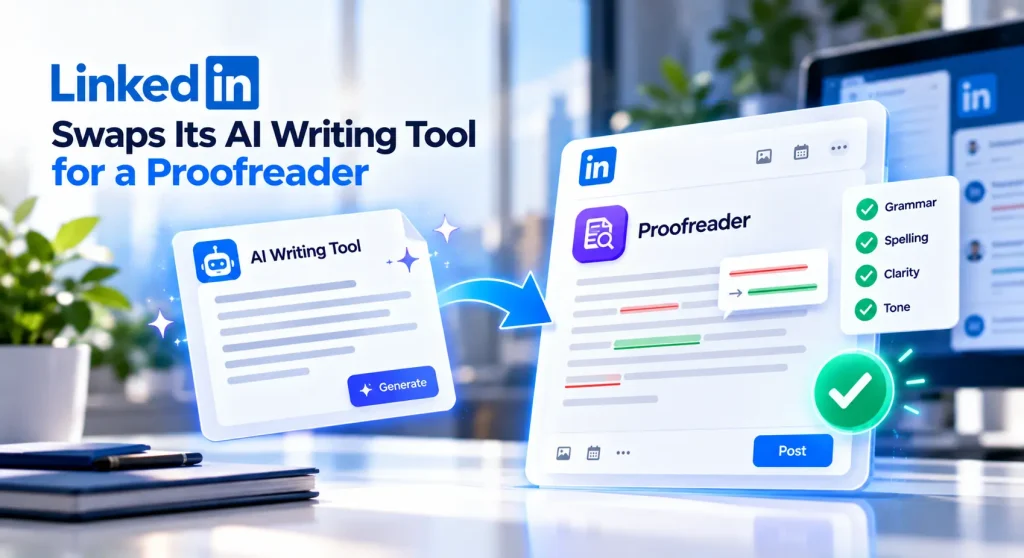
LinkedIn has launched a new feature for Premium subscribers called Post Proofreader, taking the place of the AI-improved post original feature that it quietly departed with last month. The original allowed users to generate an entire update with AI within the post editor, while the new offering has a much more conservative concept: editing a user-written post.
What Post Proofreader Actually Does
LinkedIn provides a basic description of a tool named Post Proofreader, intended for Premium subscribers. Post Proofreader helps eligible Premium members improve post drafts before publishing. You can review suggested changes and decide whether to apply them. The suggestions are presented in a comparable manner to those in Microsoft Word, using ‘inline change tracking’, therefore allowing users to examine precisely what has been edited.
Three upgrade options are available to Premium members when enhancements are recommended. Enhancements tend to focus on improving the language and structure of the user’s work, rather than providing new ideas or information that they may not have incorporated into their writing.
This is the reverse of the previous ‘post enhancement’ feature: previously, a vague suggestion could generate a complete post, whereas Post Proofreader is designed to enhance the language of a post the user has written themselves.
There is also a fundamental difference in terms of the user experience between the two proposed tools. Using prompts to generate a post implies a certain amount of interaction with the blank page, leaving the model to generate the tone, structure, and content of the writing from the beginning. Proofreading, on the other hand, works from the opposite direction: the user writes their own text and the model works from there, suggesting changes and improvements that fit within their own text. The difference in approach is significant – and not only in cosmetics, since it determines who ultimately writes the published post.
Why LinkedIn Killed the Old Tool
LinkedIn removed the post enhancement feature last month; at the same time, it was introducing another batch of measures to combat the wave of AI slop through the network. In late July, a reporting feature was added that enabled members to report posts they thought to be AI generated.
That reporting tool has become popular fast. Within around two weeks of it going live, LinkedIn Chief Product Officer Hari Srinivasan claimed that people had clicked the reporting tool more than one million times, an indication of how frustrated users had become with low effort, AI generated posts crowding out authentic content. LinkedIn has said posts classified as AI slop have seen view counts drop by roughly 40 percent since the reporting tool was introduced as LinkedIn includes user reports into the signals it uses to determine how much of the wider user base sees a particular post.
LinkedIn brought that reporting feature to comments earlier this month, applying the ban to the automated responses that had been polluting discussion threads.
Putting that into context, removing an AI-writing-instigator and replacing it with a proofreading tool feels less like a small feature swap and more of a tidy-up before urging users to help tidy-up theirs.
The timing lines up too closely to be a coincidence. LinkedIn spent the back half of the summer building out detection and reporting systems aimed squarely at AI generated posts and comments, then turned around last month and retired its own AI writing feature. A company that is actively encouraging users to flag AI generated content would have a hard time defending a built-in tool that does the same thing the reporting button exists to catch.
A Careful Bit of Rebranding
LinkedIn is not only updating the feature, but also its name, which suggests a change in what the tool does; proofreading implies a more limited set of tasks than does post enhancement, which suggested that the AI was actively generating or building upon a post. By framing it as a proofreader, LinkedIn retains the ability to provide an AI-assisted tool while not outright contradicting its own opposition to AI-generated content.
A proofreader checks for grammatical and spelling errors as well as awkward phrasing in a piece of writing that otherwise is already written by someone else. This framing does not suggest that the AI would develop concepts or generate paragraphs of text, at least not per LinkedIn’s own description of the tool. The extent to which the practice remains clean in its usage is difficult to say, but the framing still indicates to the user the direction in which they should be using the tool.
What This Says About LinkedIn’s AI Strategy
All in all, these actions are indicative of what LinkedIn seems to be attempting to do; a relatively tightrope walk. It appears to be attempting to keep offering AI tools as a paid Premium feature, as those features seem to be part of how the company bolsters its fee, but will be under increasing pressure from users the company needs to provide more authentic and less generic or dishonest-sounding material to its users.
Proofreading threads the needling into submission. It keeps an AI feature in the product without directly contributing to the volume of AI generated writing users are actively flagging and pushing back against. It also fits into a larger pattern we see throughout the AI industry, where different AI functionalities are being separated into two categories AI as a helper for editing, and AI as the real creator reach one approached as a very different entity.
Whether users will see that distinction as useful is another matter. Some may be glad to have a device that notices their errors and shows their clumsy turns of phrase without refashioning what they really wish to say. Equally many may react to any AI device touching their post, even in a helpful editing role, with the same trepidation that has produced over a million AI clutter reports in the past couple of months. LinkedIn’s assumption is that form and content go hand in hand here, and that a device designed to keep a person’s character intact will be experienced very differently from one designed to put a new character in its place.
What to Watch Next
The real test for Post Proofreader will be whether its suggestions actually stay in the lane LinkedIn has described. If the rewriting tool modifies sentences so heavily that the resulting post barely reflects the author’s initial input, the rebrand from enhancement to proofreading will start to look like semantics rather than substance
It will also be worth watching if other comment threads or articles receive similar tracked change-style updates, as the company has already been waging a campaign against artificial replies. For now, Post Proofreader only represents a minor tweak to the service, one that nevertheless captures the larger trend of LinkedIn’s ongoing attempts to both embrace and reject the power of AI-generated assistance. This balancing act is not exclusive to the social network, but it has to perform this tightrope walk more carefully than most, as its entire existence is built upon encouraging users to share content that reflects their professional expertise, not a generic knowledge model.
A proofreading tool that stays quietly in the background, catching typos without reshaping a person’s voice, fits that goal. A tool that quietly does more than advertised would undercut it just as fast as the feature it replaced. If anything, such a feature would undermine LinkedIn’s authority as a professional social network by doing too much.
FAQs
Q 1: What is LinkedIn’s Post Proofreader?
Post Proofreader is a new LinkedIn tool for eligible Premium members that reviews post drafts and suggests edits to enhance post wording and clarity before publishing, with inline change tracking so that users can accept or reject each proposed change.
Q 2: What happened to LinkedIn’s post enhancement tool?
LinkedIn discontinued post enhancement last month, a feature that allowed users to rewrite or generate post content using AI directly within the editor.
Q 3: How is Post Proofreader different from post enhancement?
While Post Proofreader does not include options to regenerate post drafts with suggested edits, it was designed to offer suggestions for improving a post’s language and structure based on a draft that the user writes, whereas post enhancement could generate new content and ideas, making it easier to publish posts that did not truly represent the user’s own words and ideas.
Q 4: Is Post Proofreader available to all LinkedIn users?
No. It is currently limited to eligible Premium members.
Q 5: Why did LinkedIn make this change?
The change comes after increased user backlash against AI generated content on the platform, including an AI slop reporting tool that was used more than one million times within weeks of its launch.
Q 6: What is LinkedIn’s AI slop reporting tool?
It is a feature that allows users to flag posts, and more recently comments, they believe were generated by AI, which LinkedIn utilizes as one of several signals to reduce the reach of that content.
Q 7: How much has AI slop reporting affected content on LinkedIn?
Posts that were labeled as AI slop have seen view counts decrease by roughly 40 percent since the launch of the reporting tool, according to LinkedIn.
Q 8: Does Post Proofreader generate new content for users?
No, LinkedIn has emphasized that the tool exists to assist with revising a post’s language and structure based on a draft the user writes; it does not suggest new ideas or paragraphs.
Q 9: Can users see exactly what changes Post Proofreader suggests?
Yes, suggestions will be displayed inline with change tracking, like a tracked change in a word processor, so that users can review and accept or reject each edit.
Q 10: Does this mean that LinkedIn is abandoning AI features?
No, but the company is making a distinction between AI as an editing tool and AI as a means to generate new content.
