








What is an SEO competitor analysis?
An SEO competitor analysis compares your website with the sites that outrank you in Google. It shows where competitors are stronger, such as more authoritative backlinks, faster pages or content for keywords you don’t cover, and where you already lead. The result is a prioritized list of actions that move you up the search results.
This tool runs the same analysis our SEO team uses for client strategy work. It pulls live data for your site and up to three competitors and turns it into a presentation-ready report you can share with your team or clients.
What’s in your free report
| Section | What you get |
|---|---|
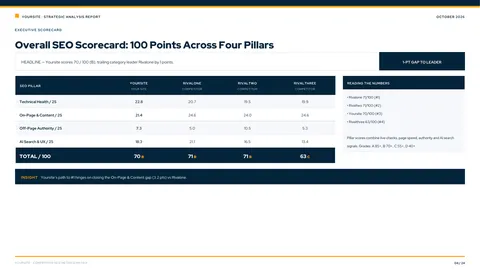
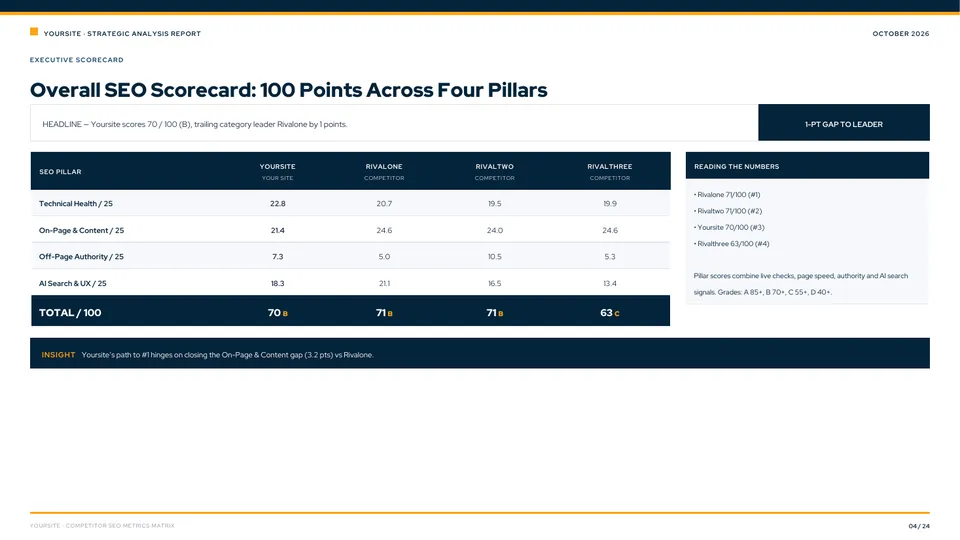
| Executive scorecard | A 100-point SEO score for every site across technical health, on-page content, off-page authority and AI search |
| Technical audit | Twelve checks on your home page, from HTTPS and sitemaps to schema, image alt text and AI crawler access |
| Page speed | Mobile and desktop Lighthouse scores and Core Web Vitals for every site |
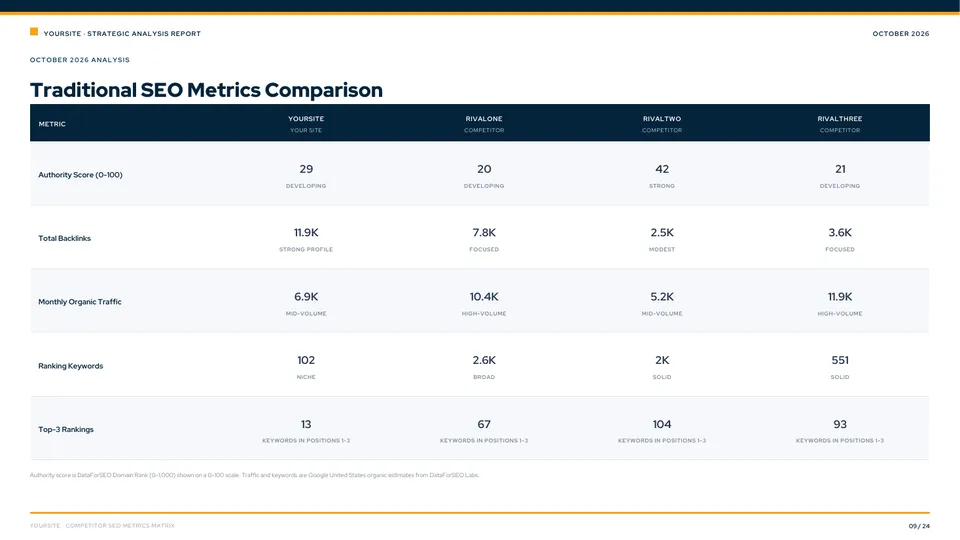
| Competitor benchmarking | Authority score, backlinks, referring domains, organic traffic, ranking keywords and positioning |
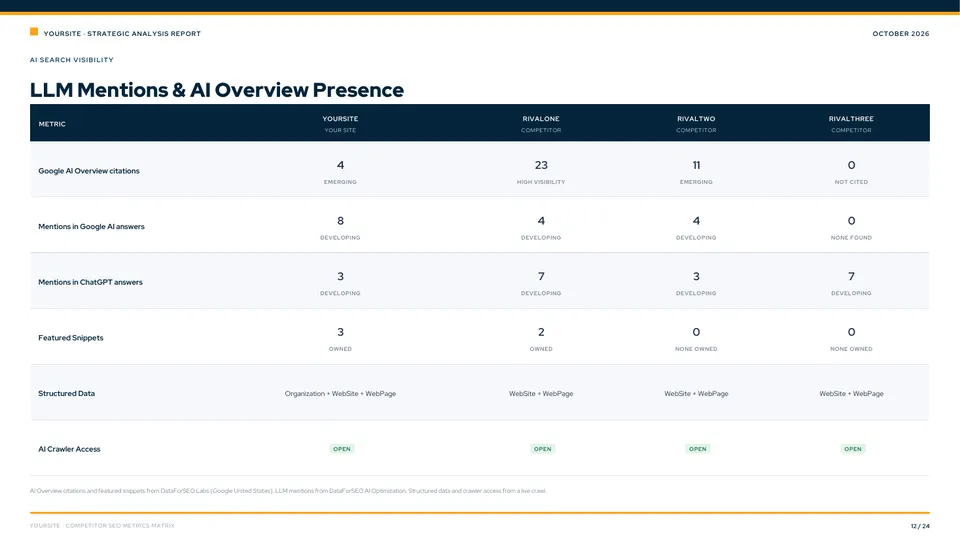
| AI search visibility | Google AI Overview citations, mentions in ChatGPT and Google AI answers, and featured snippets |
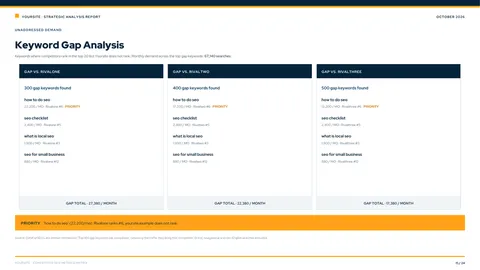
| Keyword opportunity | Your top 10 keywords with competitor ranks, plus the gap keywords competitors rank for and you don’t |
| Content and CRO | Content footprint and freshness, five content plays and ten conversion improvements |
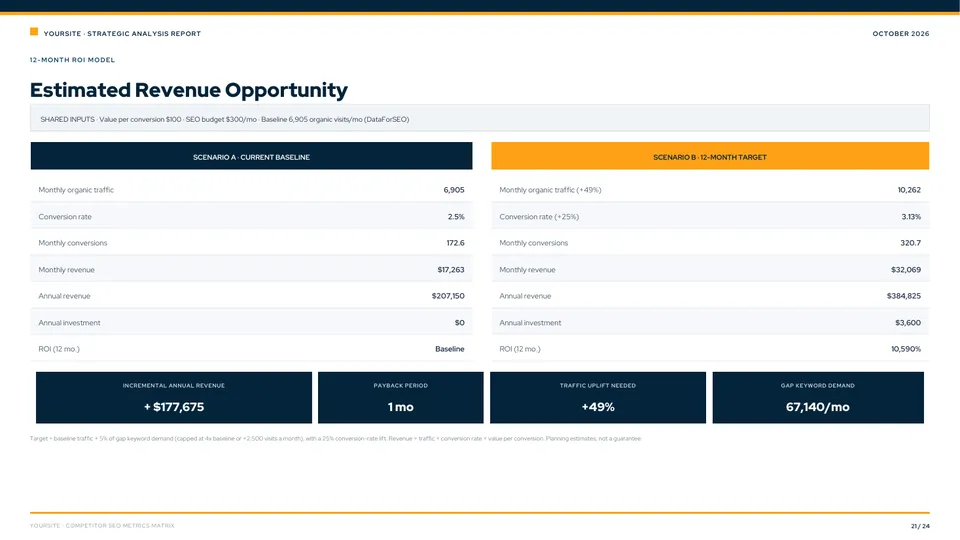
| ROI model | A 12-month revenue estimate showing what closing the gap could be worth |
How to do an SEO competitor analysis
- Pick the right competitors. Use the sites that rank above you for your most valuable keywords, not just your business rivals.
- Compare authority. Referring domains and authority score explain much of the ranking gap.
- Find keyword gaps. List the keywords competitors rank for in the top 20 where you don’t rank at all, and prioritize by search volume and fit.
- Check technical health and speed. Slow or broken pages cap how high good content can rank.
- Review content and positioning. Compare the promises, page types and publishing cadence that win clicks.
- Check AI search visibility. See which sites Google AI Overviews and ChatGPT cite, and why.
- Turn it into a plan. Rank fixes by impact and effort and review progress monthly.
The tool above does steps 2 to 6 for you and drafts step 7.
How to choose competitors to analyze
- Search competitors: the domains that appear on page one for your main keywords. They may be directories, publishers or national brands, not only direct rivals.
- Business competitors: the companies your customers compare you with.
- Aspirational competitors: a site one tier above you, to see what it takes to get there.
For the most useful report, include at least one site that outranks you for your most important keyword.
How we calculate the SEO score
Each site gets up to 25 points in four pillars:
- Technical health: HTTPS, robots.txt, sitemap, canonical, viewport, render-blocking resources, AI crawler access and page speed.
- On-page and content: title, meta description, H1, structured data, image alt text and content depth.
- Off-page authority: authority score based on the site’s backlink profile.
- AI search and UX: structured data, AI Overview citations, LLM mentions, mobile performance and crawler access.
Grades: A is 85 or more, B 70 or more, C 55 or more and D 40 or more.
Frequently asked questions
Is this SEO competitor analysis tool free?
Yes. The report is free. We ask for your first name and email so we can send it to you. There is a limit of a few reports per person per day.
How long does the report take?
Usually 3 to 5 minutes. We run live page speed tests on every site, which takes the most time. You can close the page; the report will still arrive by email.
Where does the data come from?
All SEO metrics come from DataForSEO, which supplies data to many SEO platforms: Google rankings and traffic estimates, backlinks, AI search data, a live crawl of each home page and Google Lighthouse speed tests. Sitemap size and freshness come from each site’s public XML sitemap.
How many competitors can I compare?
You can compare your website with up to three competitors in one report. At least one competitor is required.
What is the best way to analyze competitors for SEO?
Compare authority, keyword coverage, technical health, speed and content with the sites that outrank you, then fix the biggest gaps first. Most sites gain the most from targeting gap keywords and earning links from relevant sites.
Can agencies use this report with clients?
Yes. Agencies use the report to open conversations with prospects and to benchmark clients. ALM Corp also delivers white label SEO under your brand.
I did not receive my report. What should I do?
Check your spam or promotions folder for an email from ALM Corp. If it is not there after 10 minutes, contact us and we will resend it.