





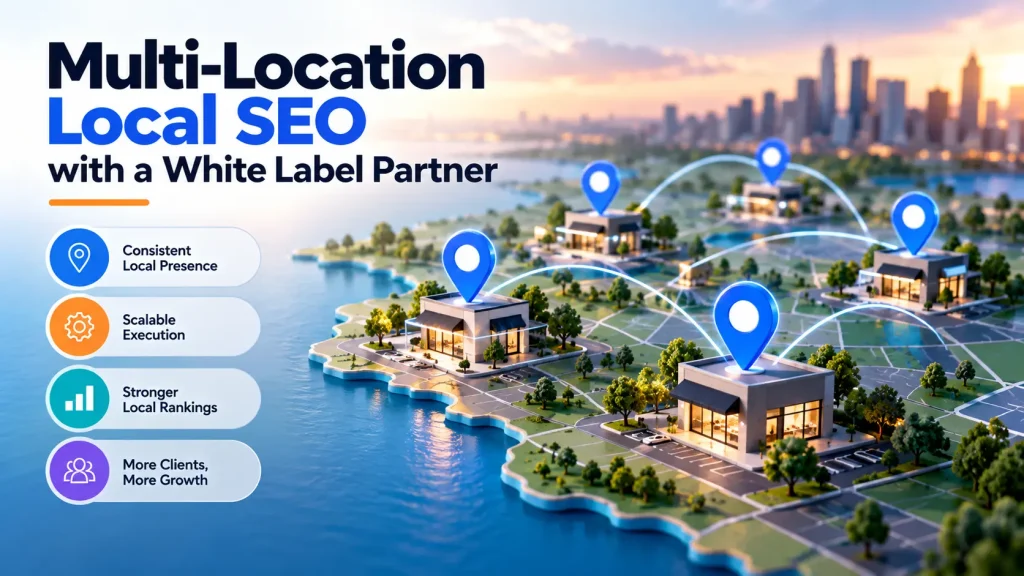
SEO management for just one business location is quite a task, from optimizing its Google My Business listing, through website optimization, to managing business listings. The situation is going to be even more complex in those cases where clients are doing business not only in one city, region or state but across many locations.
For digital marketing agencies, this means that there is an opportunity to provide their clients with multi-location local SEO service by themselves without employing large teams.They simply need to find a white label partner who will handle everything in the background for them.
What is important is to find a partner who knows the difference between doing the SEO stuff over and over again at various locations and actually creating a strategy for every individual location. The goal of this guide is to explain how multi-location local SEO works, what should be offered by a white label partner, and how you can run your agency effectively.
What Is Multi-Location Local SEO?
Multi-Location Local SEO is an approach where the local optimization of the business in search results is done for multiple physical locations or service areas. The components of multi-location Local SEO include web optimization, local listings, Google My Business optimization, reputation management, and location-based content to help customers locate the specific location or service provider.
Example of Multi-Location Local SEO would be a dental group with 12 locations. In such a case, the business would like to optimize each location in the local search results. This can also apply to a home service business running across several cities and a retail chain which would like to get its customers to know the nearest store among other information.
The point isn’t only about getting the entire brand higher. This should be about ranking in the right location based on the proper keywords.
What Sets Multi-Location Local SEO Apart from Single Location Local SEO?
In many scenarios, it’s all about a single-location local SEO strategy that requires a single Google My Business listing, one market only, and several location-specific pages. The multi-location SEO approach will have to integrate all these aspects in several branches while being careful not to have redundant data.
| SEO activity | Single-location SEO | Multi-location local SEO |
| Google Business Profile | One eligible location | Multiple eligible profiles |
| Keyword research | One primary market | Location-specific keyword groups |
| Website content | Core service and location pages | Unique pages for relevant branches and markets |
| Business listings | One main business listing set | Accurate data for each location |
| Review management | One review stream | Multiple location-level review streams |
| Reporting | One overall performance view | Consolidated reporting with location-level detail |
| Quality control | Smaller workflow | Standardized processes and location-by-location checks |
The challenge is to create a repeatable system without making every location look identical to search engines or customers.
What Businesses Will See Benefits from Multi-Location Local SEO?
There are some types of businesses which benefit greatly from multi-location local SEO. Some common types of businesses are:
Businesses operating as franchises or retail chain businesses which require accurate information of their stores. For instance, health care providers like dental clinics.
Professional firms like law firms and accounting practices which operate in various locations.
Businesses providing home services: Plumbers, electricians, HVAC contractors, and other types of contractors that operate in more than one city.
Restaurant and hospitality businesses: Chains of restaurants that need localized data and reviews from users.
Automotive businesses: Auto dealership chains, auto repair shops, and auto service shops with separate branches.
Each business is unique and has different requirements depending on the nature of the business. The SEO plan should be tailored accordingly.
Reasons Why an Agency Works with a White Label SEO Partner When Managing Multi-Location Local SEO Campaigns
An agency hires a white label SEO company to provide SEO services to sell under the branding of the agency. While the white label SEO company executes what is expected, the agency deals with the customer relationship management part and makes the presentation.
This works great when the agencies cater to business customers having multiple locations because then there is no need to hire experts for different things. They only have to deal with an already experienced fulfillment team.
Scaling Without Increasing Internal Workforce
The maintenance of 20 or 50 locations may include quite some time spent on researching keywords, making list updates, writing content, technicalities, review process and reporting. When you have an internal team who does all the website design, PPC, content marketing and communicating with clients, you may find it difficult to maintain.
A white label agency may help execute those agreed actions, while leaving strategy planning, account management, sales and clients retention up to you and your team.
But even when you outsource work, it doesn’t mean that control goes away. An agency should be doing reviews of deliverables, measuring campaign efficiency and ensuring the results are meeting the needs of the client.
Deliver Consistent Services Across Every Location
A dependable partner can set up standard procedures for repeatable tasks such as business information verification, page optimization, reporting, and review monitoring. Standardization helps avoid task omission in cases where there are many locations involved in the campaigns.
The standardization has to be about the procedure rather than the content. Every spot requires correct data and right message according to its services, staff, facilities, service area, and marketplace.
Improving Delivery Effectiveness and Profitability
The establishment of an in-house team implies expenses in terms of salary, training, instruments, control and QA. The white label model enables the agency to buy delivery within a certain scope agreed upon.
That makes it possible to better estimate the cost of multi-location packages and to control delivery costs. This is beneficial commercially, depending on the partner’s rate, complexity of the campaign, control efforts needed and the fee charged by the agency to its clients.
Consider the total cost of delivery when selecting a provider, not just the cost of fulfillment.
What Must Be Included in a White Label Multi-Location Local SEO Service?
An efficient multi-location local SEO service must integrate central control with location-level implementation.What this means exactly depends on how locations the client has the type of industry they are in, where they operate geographically and if they want a full implementation or just a recommendation service.
Before agencies offer this service it is very important to explain what will be delivered. This way clients know exactly what is included, which parts need their approval before starting and how success will be measured.
1. Multi-Location SEO. Strategy
An ideal SEO campaign starts with assessing the status of the business’s local SEO campaign. This will set a benchmark and determine which locations require urgent attention.
A possible SEO audit can consist of:
Analysis of all potential Google Business Profiles.
Location-page quality and indexation checks.
Local keyword and competitor research.
Duplicate or conflicting business listing checks.
Review profile analysis and response practices.
Website technical issues affecting local landing pages.
Data from available analytics, search results, and conversion tracking.
The results should provide a framework for prioritization. For instance, a site with the wrong address or an unconfirmed profile would need more attention than a branch with a confirmed profile that needs content updates.
2. Google Business Profile Management
Google My Business Listings will help eligible businesses get listed in local search and Google Maps. In case of businesses that operate in multiple locations, each entry will need to accurately depict those.
The white label vendor may take responsibility for carrying out profile audits, suggestion of the categories, business description, services provided, photo submissions, availability times, updates, review replies management, etc.
The vendor must follow the guidelines for Google business representations. Agencies must refrain from creating any duplicates for a particular location as well as making up the addresses of the virtual offices.
Access control must be done in such a way to give proper permission to the agency, client and fulfillment partner. Control over business data should be within the hands of the client.
3. Location Specific Website Pages
A company with multiple branches would require separate landing pages so that customers can get information about each branch. It will also help search engines determine what services are available in which market.
A useful location page may include:
The location’s actual name and address, where applicable.
Phone number and opening hours.
Services offered at that branch.
Information about staff, facilities, or any other real information specific to the location.
Information about directions, parking, or access where necessary.
Links to other related services and other location pages.
Do not create many pages that are just a slight variation on the name of the city. Each page must be useful for someone from that market. Do not include information in the page that implies that you offer the service in a location where you don’t.
4. Local Keyword Research & On-Page Optimization
Keyword research should include not just the business service offerings of the firm, but also their geographical position and local customer behavior and queries. Queries such as “plumber near me emergency” and “Denver commercial plumbing contractor” have completely different meanings, even though both are related to the exact same type of business.
The partner has to sort out keyword lists into separate pages, so as to avoid competition between two pages for the same intent of search unless it is absolutely necessary.
On-Page Optimization can be done using such means as title tags, descriptions, headings, internal linking, image descriptions, and service descriptions. The idea is to make each and every page helpful and relevant, without repeating keywords regarding locations.
5. Citation and Business Listing Management
“Citation” refers to references made to an organization’s information through online directories and any other sources on the internet. This is because citations serve the purpose of making it easier for customers to get the right information about an organization by having it in an accurate form. In multi-location marketing campaigns, the partner can do listing audits and also provide directory listings.
The process should be managed at the location level. Changing the address or telephone number of a particular office should not affect or overwrite those of other offices inadvertently. There needs to be clarification from organizations regarding what directories need to be included, what numbers are going to be included, and monitoring requirements.
6. Reviews Management and Reputation Management
Reviews from consumers can impact the perception of the company before they make any calls, bookings, or visits. Multi-branch companies have to have a system of managing reviews from their branches and respond consistently.
The white label partner might provide review management services such as draft responses, sentiment analysis, and ways of boosting the review process. The agency should be aware of whether the partner will post the replies or not.
Review acquisition must follow platform policies. Businesses must refrain from buying reviews, offering bribes to get good reviews, or asking reviews from customers who can leave good reviews. This is because a good review system is one where there is honest feedback and professionalism in solving customer issues.
7. Local Authority and Link Building
Reputable links from local sources, community papers, trade associations, and legitimate business partnerships can add to a site’s authority online. The opportunities will depend upon the particular markets, and therefore each individual franchise’s marketing campaign mustn’t attempt to build the same links for each branch. It must be noted that the partner must be able to describe the way he builds his links. The agencies must be very careful when buying cheap links claiming the first position purely by the volume.
8. Technical SEO and Structured Data
Technical SEO would assist in the discovery, crawling, and indexing of location-based pages on the site. Since the website will expand, the agency must deal with some problems, which include: indexing, page speed, mobile usability, redirects, internal linking, canonicalization, and duplicate content.
The data provided should be legitimate and reflect the data on the page; it shouldn’t be used as a way of getting higher rankings.
The implementation should correspond to the site architecture and real structure of the company. Changes should be tested carefully, especially if there is one template for many location pages.
9. Location-Based and Consolidated Reporting
The reporting should enable analysis of the entire business performance as well as the performance of individual locations.
An effective report might contain:
Organic search clicks and impressions.
Local keyword visibility and ranking trends.
Google Business Profile performance data where available.
Calls, appointment requests, form submissions, or other tracked conversions.
Changes to business listings and location pages.
Review volume and response activity.
Completed tasks, outstanding work, and next steps.
Expand Your Agency’s Multi-Location SEO Services With ALM Corp
Managing local SEO across multiple locations requires accurate business data, relevant location pages, consistent optimization, and clear reporting. A white label partner can help agencies deliver this work at scale without building every specialist function in-house.
ALM Corp provides white label SEO solutions for digital marketing agencies, including local SEO, regional SEO, location-specific content, business profile optimization, and centralized performance reporting. Agencies can use these services to expand their delivery capacity while keeping client relationships and brand communication under their control.
Explore ALM Corp’s white label services for agencies or learn more about its Regional SEO Services to assess how a structured multi-market SEO program could support your agency’s clients.
